

ESG Metrics that Actually Matter in Manufacturing
Why Equipment Level Data is Becoming the New Standard for Sustainability Reporting
ESG Reporting is Getting Harder, More Specific, and More Relevant than Ever.
If you are responsible for sustainability reporting in manufacturing, you've likely felt the shift. It is no longer enough to say: “We reduced energy consumption" or "We're improving efficiency". Today, customers, boards, and regulators want quantifiable, traceable data, and they want it tied directly to operational decisions. That is where ESG comes in.
What is ESG and Why it Matters in Manufacturing?
ESG=Environmental, Social, and Governance.
While all three pillars matter, the Environmental component is where manufacturing operations and specifically equipment have the most immediate and measurable impact. This includes:
- Energy consumption (kWh)
- Water usage
- Emissions and waste
- Process efficiency and throughput
Here is the key shift: ESG performance is no longer evaluated at the facility level alone. It's increasingly measured at the process and equipment level.
The Problem with Traditional Manufacturing Metrics
Most maufacturers still report sustainability using high-level numbers:
- Total plant energy usage
- Annual water consumption
- Overall waste reduction
While useful, these metrics do not answer a critical question: “Where is the inefficiency actually coming from?" Without that visibility, it's nearly impossible to:
- Improve performance
- Justify capital investments
- Connect engineering decision to ESG outcomes
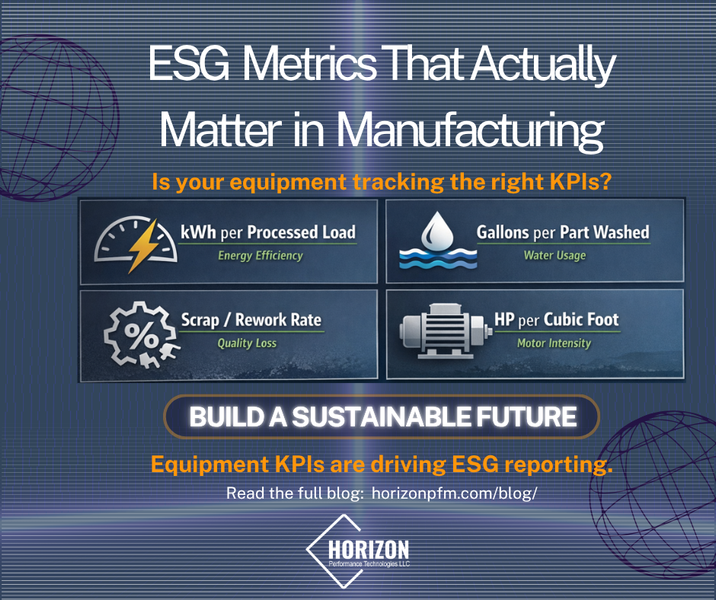
4 Equipment-Level ESG Metrics that Actually Matter
To build meaningful ESG benchmarks, manufacturers need to track metrics that directly tie equipment performance to environmental impact. Here are four that stand out:
1. kWh Per Processed Load
Not total facility energy, but energy per unit of production. This reveals:
- True process efficiency
- The impact of airflow design and heat transfer
- Energy wasted during recovery or idle time.
2. Water Gallons Per Part Washed
Water usage is often overlooked until it becomes a cost or compliance issue. Tracking per-part usage highlights:
- Spray efficiency
- Coverage effectiveness
- Opportunities to reduce chemistry and wastewater
3. Rework / Scrap % Tied to Thermal Inconsistency
Scrap is not just a quality issue, it's an ESG issue. Every rejected part represents:
- Wasted energy
- Wasted material
- Additional processing time
Thermal inconsistency is one of the most common and preventable contributors.
4. Fan & Pump Motor HP per Cubic Foot of Chamber Volume
This metric exposes hidden inefficiencies in system design. Oversized motors often compensate for:
- Poor airflow paths
- Inefficient spray dynamics
- Lack of process control
The result? Higher energy consumption with no performance benefit.
Where ESG Becomes Real: Equipment Design
These metrics do not exist in isolation. They are the direct result of engineering decisions such as:
- Airflow architecture
- Motor sizing and control strategy
- Heat transfer efficiency
- Spray coverage and impingement dynamics
- System recovery time
In other words, your ESG performance is largely determined before the equipment is ever installed.
The Role of Advanced Process Technologies
Modern equipment design is shifting away from "more power" toward smarter, more efficient systems.
Optimized Airflow: Cyclone Technology™
Instead of relying on high horsepower and turbulent airflow, optimized circulation systems like Horizon’s Cyclone Oven™:
- Eliminate short-circuiting
- Deliver consistent heat transfer across the load
- Improve temperature uniformity
The result is reduced fan horsepower, faster recovery times, and lower energy consumption per load.
Efficient Cleaning: Torrent Technology™
Traditional wash systems often rely on pressure alone. More advanced approaches like Horizon’s Torrent Washer™ use dynamic, multi-directional impingement to:
- Reach complex geometries
- Improve cleaning coverage
- Reduce reliance on excessive water and chemicals.
The result is lower water usage per part, reduced chemical consumption, lower pump horsepower, and decreased wastewater and disposal costs.
Sustainability is a System, not a Feature.
One of the biggest misconceptions about ESG is that it can be solved with a single upgrade. In reality, sustainability in manufacturing is:
- The sum of airflow design
- Motor efficiency
- Process control
- Equipment integration
Small improvements across each area compound into lower operating costs, reduced environmental impact, and stronger ESG reporting.
From Reporting to Action
The companies leading in ESG are not just reporting better numbers. They are:
- Tracking the right metrics
- Connecting performance to engineering decisions
- Investing in systems that reduce resource intensity at the source
Sustainable equipment design is not a trend—it is becoming a purchasing requirement.
The manufacturers who understand this shift will be the ones who:
- Win more business
- Reduce long-term operating costs
- And build ESG programs backed by real, defensible data