
Industrial FINISHING SYSTEMS
Horizon Performance Technologies designs and manufactures integrated industrial finishing systems that streamline production, improve efficiency, and deliver consistent, high-quality results. Our custom-engineered solutions combine industrial parts washers, dry-off ovens, automated finishing application equipment, and curing ovens into a seamless production line. Designed around each customer's specific process, our systems optimize workflow, reduce operating costs, and provide the flexibility to meet evolving production demands.
HOW AN INDUSTRIAL FINISHING SYSTEM WORKS
An industrial finishing system moves manufactured parts through a series of processes designed to prepare surfaces, apply protective or decorative coatings, and achieve the required finish quality. Depending on the application, the process typically begins with cleaning, chemical pretreatment, or abrasive blasting to remove contaminants and prepare the substrate for coating adhesion. Parts are then dried as necessary before powder coating or liquid paint is applied. Finally, a curing oven provides the controlled heating required to develop the coating's specified properties.
Each stage of the finishing process must be carefully coordinated to maintain consistent processing conditions, efficient material flow, and reliable production throughput. Proper system design begins with understanding the parts being finished and the specific manufacturing requirements.
Factors to Consider When Designing a Finishing System
Designing an efficient industrial finishing system requires careful evaluation of the parts being processed, production requirements, coating specifications, and available facility space. Important engineering considerations include:
- Part Size: Overall dimensions and geometry of the parts being processed.
- Part Composition: Substrate materials, such as steel, aluminum, or other metals, that influence pretreatment and coating requirements.
- Part Weight and Thickness: Material characteristics that affect handling, heating requirements, and processing time.
- Required Production Rate: The number of parts to be processed per hour or shift, including anticipated future capacity needs.
- Part Conveyance Type: Continuous, indexing, power-and-free, or manual material handling systems based on production volume and process requirements.
- Number of Pretreatment Stages: The cleaning, rinsing, and chemical treatment stages required to achieve the desired surface preparation and coating adhesion.
- Spray or Immersion Pretreatment: Selection of the appropriate cleaning method based on part geometry, contaminants, and surface preparation requirements.
- Blow-Off Requirements: Compressed air or mechanical blow-off systems to remove excess water from part surfaces, recessed areas, and cavities before drying.
- Drying Time and Temperature: The time and temperature needed to remove moisture following pretreatment while accommodating part material, thickness, and production speed.
- Coating Type: Powder coating, liquid painting, or other finishing materials that determine application equipment and processing requirements.
- Coating Cure Time: The required curing temperature and time at part temperature to achieve proper coating performance, adhesion, and durability.
- Available Footprint and Height: Facility floor space, ceiling height, equipment clearances, and layout constraints that influence system configuration and material handling design.
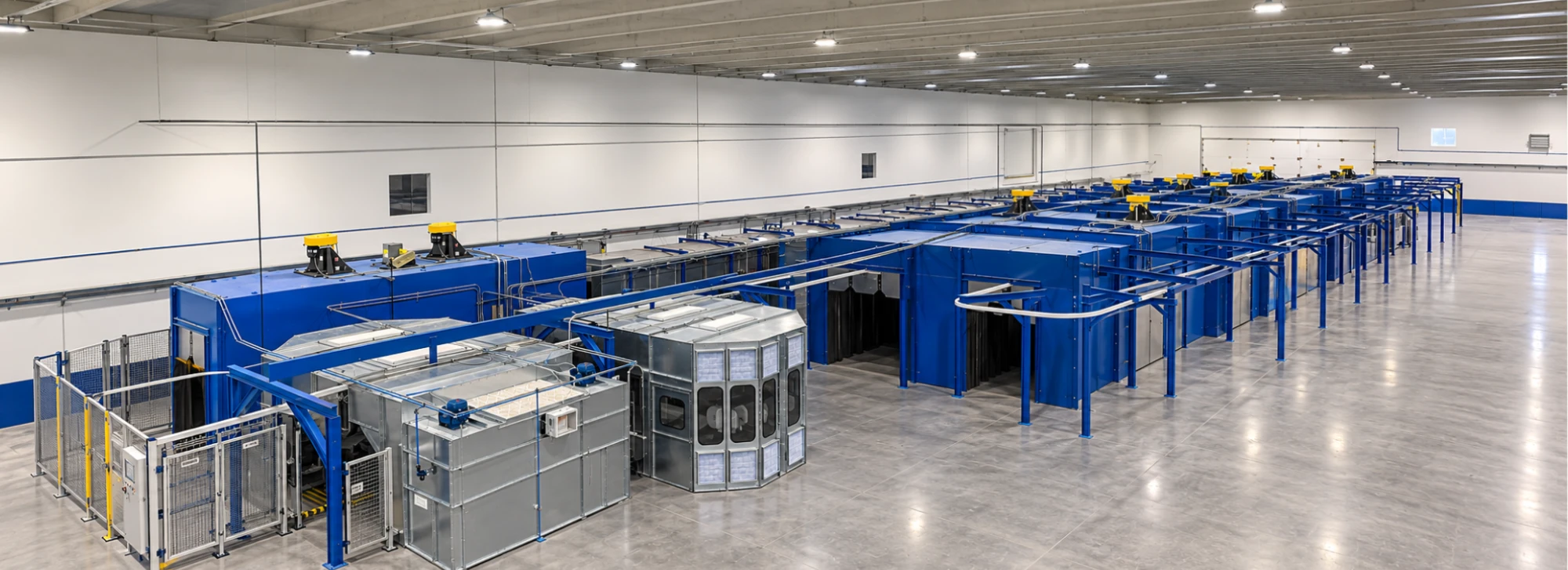
Typical Components of an Industrial Finishing Line
A complete powder coating or liquid paint finishing system may incorporate the following equipment, depending on the production process and application requirements:
- Pretreatment Equipment: Industrial parts washers, manual wash booths, and abrasive blasting equipment remove contaminants and prepare surfaces for coating. Chemical conversion coatings may also be incorporated.
- Dry-Off Ovens: Remove moisture following washing and pretreatment to prepare parts for coating application.
- Coating Application Equipment: Powder coating booths, liquid paint booths, automated applicators, and environmental rooms support controlled coating application.
- Curing Ovens: Deliver controlled temperatures and heating cycles to achieve the coating manufacturer's required cure conditions.
- Material Handling Systems: Continuous conveyors, indexing conveyors, power-and-free conveyors, and manual carts transport parts between processing stages.
- Integrated Controls: Coordinate process temperatures, conveyor movement, equipment operation, and other critical production parameters.
- Water Treatment Systems: Support pretreatment water quality, solution management, and wastewater handling as required.
Material Handling Options for Batch and Continuous Finishing
Parts can move through an industrial finishing system using continuous, indexing, or power-and-free conveyor systems, depending on production requirements. Continuous conveyors move parts at a controlled rate, making them well suited for high-volume manufacturing. Indexing and power-and-free conveyors provide additional flexibility by allowing parts to stop, accumulate, or move independently through individual processing stages. For lower-volume production, larger components, or varying part configurations, batch finishing systems using manual conveyors or carts may be more appropriate. Hybrid systems can also combine automated and manual material handling to accommodate different production needs within the same facility.
EFFICIENCY AND INNOVATION IN INDUSTRIAL FINISHING SYSTEMS
An efficient industrial finishing system depends on more than individual equipment performance. Equipment layout, conveyor routing, cycle times, and available floor space must work together to achieve the required throughput and coating quality while controlling operating costs.
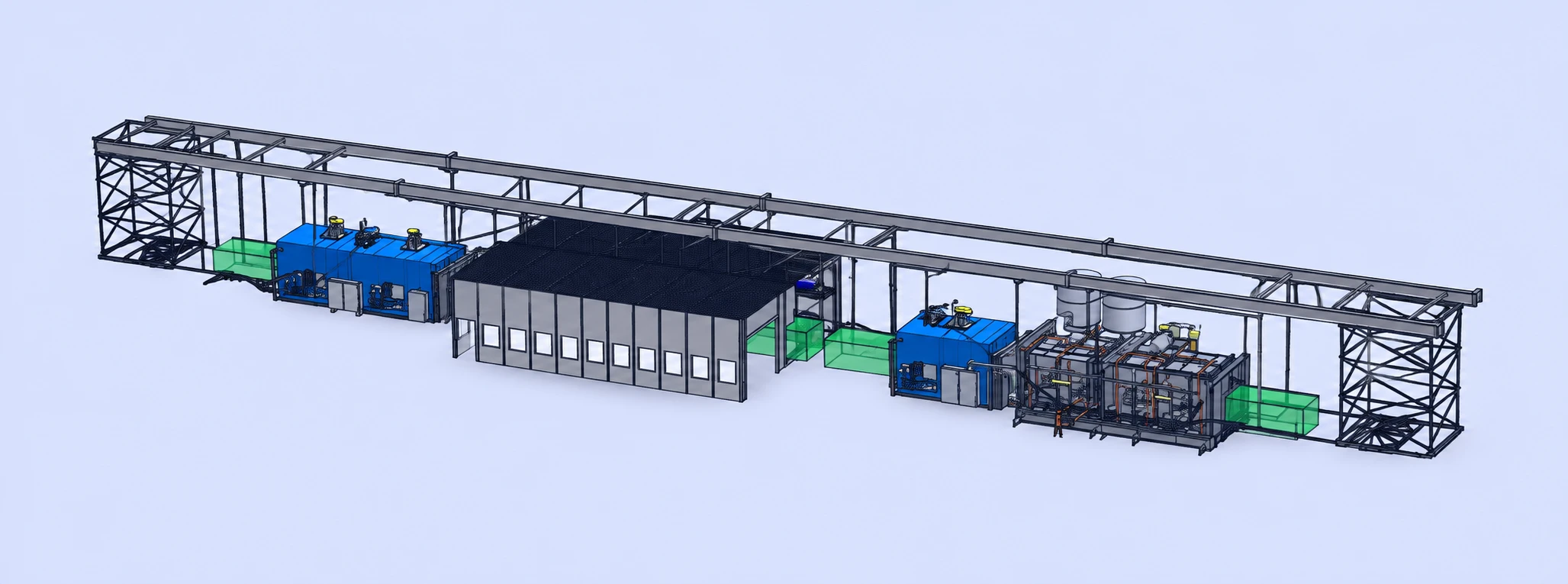
Horizon Performance Technologies engineers integrated finishing lines that coordinate pretreatment washing, dry-off ovens, coating application, curing ovens, and material handling. Proper equipment sizing and process integration help reduce bottlenecks, optimize workflow, and manage energy and water consumption. Horizon's patented Torrent Technology™ washers and Cyclone Technology™ ovens add further efficiency through advanced cleaning and heat-transfer designs, supporting consistent finishing results and long-term production flexibility.
HOW TORRENT TECHNOLOGY™ IMPROVES INDUSTRIAL PARTS WASHING
Effective surface preparation is essential to achieving consistent coating adhesion, corrosion resistance, and long-lasting finish quality. In an integrated industrial finishing system, pretreatment washers remove oils, grease, dirt, and other contaminants while preparing metal surfaces for powder coating or liquid painting. Horizon Performance Technologies' patented Torrent Technology™ improves this process by delivering more complete spray coverage while reducing the water, chemicals, and energy required for industrial parts washing.
Rotating Riser Technology for Superior Cleaning Coverage
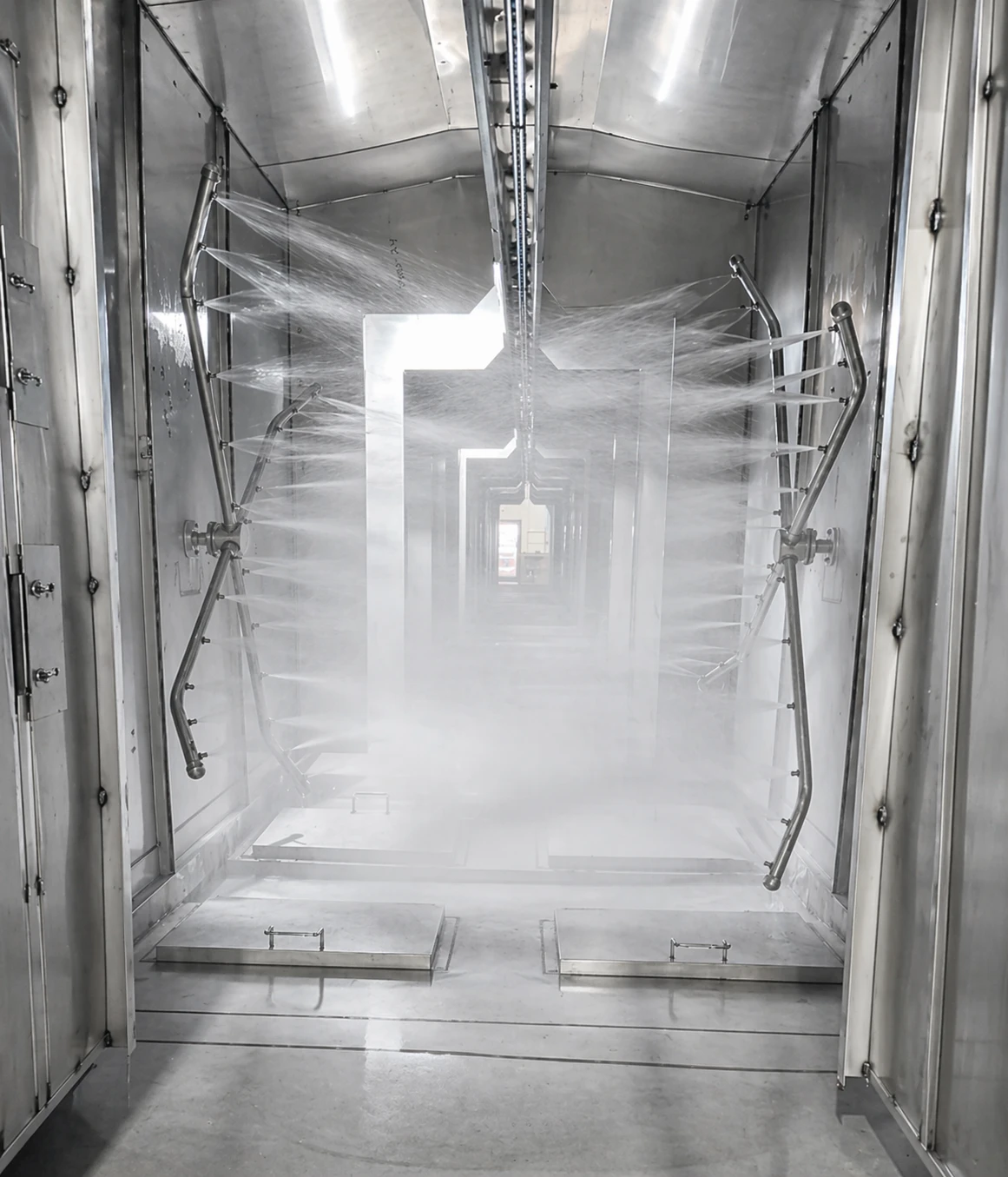
Unlike conventional industrial spray washers that rely on stationary risers and fixed spray nozzles, Torrent Washers utilize rotating riser bars that move spray nozzles in a circular pattern around the parts being cleaned. This dynamic, swirling spray pattern delivers multidirectional coverage and improved spray impingement, reaching recessed surfaces, corners, and complex part geometries that can be difficult to clean with stationary spray systems.
Because each rotating nozzle covers a greater surface area, fewer nozzles are needed to achieve effective cleaning. Torrent washer designs can utilize approximately 75% fewer spray nozzles than conventional stationary-riser systems, depending on the application. The resulting reduction in solution flow can significantly decrease pump horsepower, energy consumption, water usage, and chemical requirements without sacrificing cleaning performance.
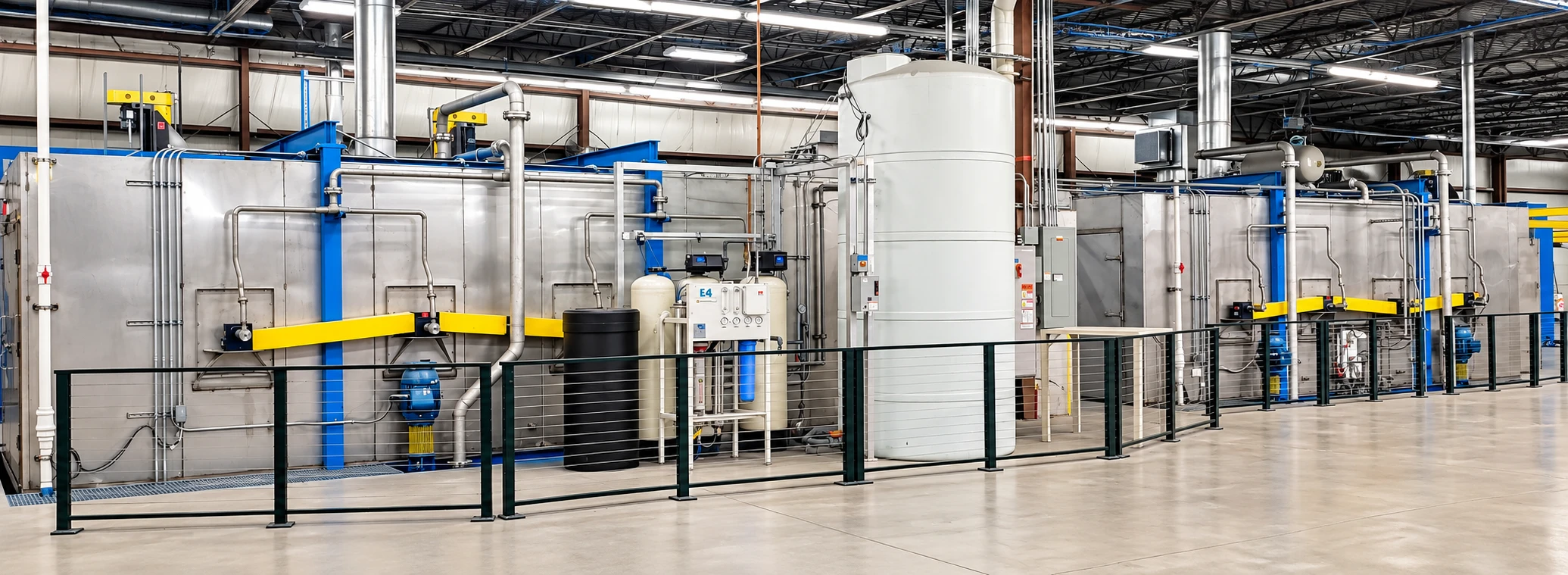
Key Advantages of Torrent Pretreatment Washers
By combining improved spray coverage with resource-efficient equipment design, Torrent Technology™ provides several performance and operating cost advantages:
- Improved Cleaning and Surface Coverage: Rotating spray risers provide multidirectional spray coverage and increased impingement to clean complex shapes and difficult-to-reach surfaces more effectively.
- Reduced Water and Chemical Consumption: Fewer nozzles and lower solution flow rates reduce water requirements, chemical usage, and solution replenishment costs.
- Lower Electrical Energy Requirements: Reduced solution flow allows smaller pumps with lower horsepower requirements, decreasing electrical consumption and operating expenses.
- Reduced Heating and Evaporation Losses: Lower solution volumes and reduced evaporation can decrease the energy required to maintain wash temperatures and reduce exhaust and facility make-up air requirements.
- Smaller Tanks and Lower Disposal Costs: Reduced solution volume can allow smaller process tanks, saving floor space and lowering the cost of treating or disposing of spent cleaning solutions.
- Reduced Nozzle Maintenance: Fewer spray nozzles mean fewer components to inspect, clean, and replace, simplifying preventive maintenance.
- Durable Stainless Steel Construction: Stainless steel process piping, nozzles, wetted pumps, and available stainless steel washer construction provide durability in demanding industrial environments.
- Advanced Process Controls: PLC and HMI controls with variable-frequency drives allow operators to adjust spray pressure, solution flow, riser rotation speed, and batch cycle times as applicable to the process.
Torrent Washers for Batch and Continuous Finishing Systems
Torrent Technology™ can be incorporated into both batch and continuous industrial pretreatment washers. Batch washers process stationary loads through sequential cleaning, rinsing, and chemical pretreatment stages, making them suitable for flexible production requirements. Continuous washers move parts through multiple pretreatment stages on a conveyor, supporting higher production volumes and integration with automated finishing lines.
When incorporated into a complete industrial finishing system, Torrent Washers provide consistent surface preparation before parts enter the dry-off oven and coating application process. This combination of effective cleaning, controlled pretreatment, and efficient equipment operation helps manufacturers improve coating quality while reducing the overall cost of finishing operations.
Learn more about the patented design, technical capabilities, and operating cost benefits of Horizon's Torrent Technology™ industrial pretreatment washers .
HOW CYCLONE TECHNOLOGY™ IMPROVES INDUSTRIAL OVEN PERFORMANCE
Temperature uniformity, heat transfer, and energy efficiency are critical to the performance of industrial dry-off and curing ovens. Horizon Performance Technologies' patented Cyclone Technology™ uses a high-volume, low-pressure airflow design to improve heat transfer to manufactured parts while reducing the electrical energy required for air circulation.
Compared with conventional industrial ovens, Cyclone designs can circulate approximately 1.5 to 2 times as much air while requiring significantly less recirculation fan horsepower. The result is faster and more uniform heating, improved process control, and opportunities to reduce oven size, cycle times, and operating costs.

High-Volume Airflow for Faster, More Uniform Heating
Conventional industrial ovens often rely on high-pressure airflow delivered through nozzles and extensive ductwork. Cyclone Technology™ takes a different approach by circulating greater volumes of air at lower pressure throughout the oven chamber. This increases average air movement across the part surfaces, improving convective heat transfer and helping parts reach the required processing temperature more quickly and uniformly.
Improved heat distribution reduces temperature variations throughout the oven and across the product load. Cyclone ovens have demonstrated temperature uniformity as tight as ±3°F in applicable configurations. For industrial finishing systems, this level of temperature control helps support consistent drying, proper coating cure, and repeatable product quality.
Key Advantages of Cyclone Industrial Ovens
Cyclone Technology™ combines advanced airflow engineering, heavy-duty construction, and precise process controls to improve oven efficiency and long-term performance. Key advantages include:
- Greater Airflow with Less Electrical Energy: High-volume, low-pressure circulation reduces airflow resistance and fan horsepower requirements. In a representative comparison at 18,000 CFM, a Cyclone design uses approximately 5 HP versus 20-25 HP for a conventional oven fan system.
- Superior Temperature Uniformity: Consistent airflow and heat distribution support uniform product temperatures, with uniformity as tight as ±3°F demonstrated in certain applications.
- Faster Heat Transfer and Reduced Cycle Times: Improved convective heating helps parts reach processing temperatures more quickly, creating opportunities for shorter drying and curing cycles.
- Variable Frequency Drive (VFD) Controls: VFD-controlled recirculation fans allow airflow to be adjusted to meet specific part and process requirements, including different airflow conditions for powder coating gel and cure zones.
- Heavy-Duty Welded Construction: A welded exterior shell constructed from 3/16-inch-thick steel reduces the seams associated with conventional panel-built ovens, helping minimize air leakage and heat loss.
- Reduced Oven Footprint: Faster heat transfer can reduce the required heated processing length, allowing more compact oven designs when process conditions permit.
- Accessible Maintenance Design: Floor-level burner access and accessible oven interiors simplify inspection, routine maintenance, and service.
- Advanced PLC and HMI Controls: Programmable controls enable operators to develop and store process recipes, manage temperature and airflow settings, and accommodate different products and coating requirements.
- Lower Long-Term Operating Costs: Reduced recirculation fan energy, improved heat transfer, and minimized heat loss help lower utility expenses throughout the equipment's service life.
Cyclone Dry-Off and Curing Ovens for Industrial Finishing Lines
In an integrated finishing system, Cyclone Technology™ provides distinct advantages during both drying and coating cure. Following pretreatment washing, Cyclone dry-off ovens use controlled heated airflow to remove residual moisture before parts enter the coating application process. Efficient heat transfer helps achieve the required drying conditions while supporting production throughput.
During powder coating and liquid paint curing, consistent part temperatures are essential for achieving the coating manufacturer's specified cure requirements. Cyclone curing ovens provide controlled temperature and airflow conditions throughout the heating process. For powder coating applications, multi-zone designs can provide gentler airflow during the initial gel stage and increased airflow during curing to optimize heat transfer without disturbing the uncured coating.
When combined with Horizon's Torrent Technology™ pretreatment washers, Cyclone dry-off and curing ovens help create a coordinated finishing process from surface preparation through final coating cure. Together, these patented technologies support improved finishing consistency, reduced resource consumption, and efficient production flow.
Learn more about the airflow design, temperature uniformity, and energy-saving advantages of Horizon's patented Cyclone Technology™ for industrial ovens .
ADDITIONAL INDUSTRIAL FINISHING SYSTEM COMPONENTS
In addition to Horizon's patented Torrent Technology™ pretreatment washers and Cyclone Technology™ industrial ovens, a complete finishing system requires properly integrated material handling, coating environments, process controls, and supporting equipment. These components work together to coordinate production flow, maintain process consistency, and support safe, efficient operation. Horizon engineers each system to meet specific manufacturing requirements, available facility space, and desired production capacity.
Conveyor and Material Handling Systems
Material handling plays an important role in determining the efficiency and throughput of an industrial finishing line. Conveyor systems transport parts between pretreatment, drying, coating application, and curing operations while maintaining the required processing speeds and material flow. Depending on part size, weight, production volume, and facility layout, Horizon finishing systems may incorporate several conveyor configurations:
- Enclosed Track Conveyors: Overhead conveyor systems that transport suspended parts through multiple finishing stages while helping protect conveyor components from the surrounding environment.
- I-Beam Conveyors: Heavy-duty overhead systems designed to support larger and heavier parts throughout the finishing process.
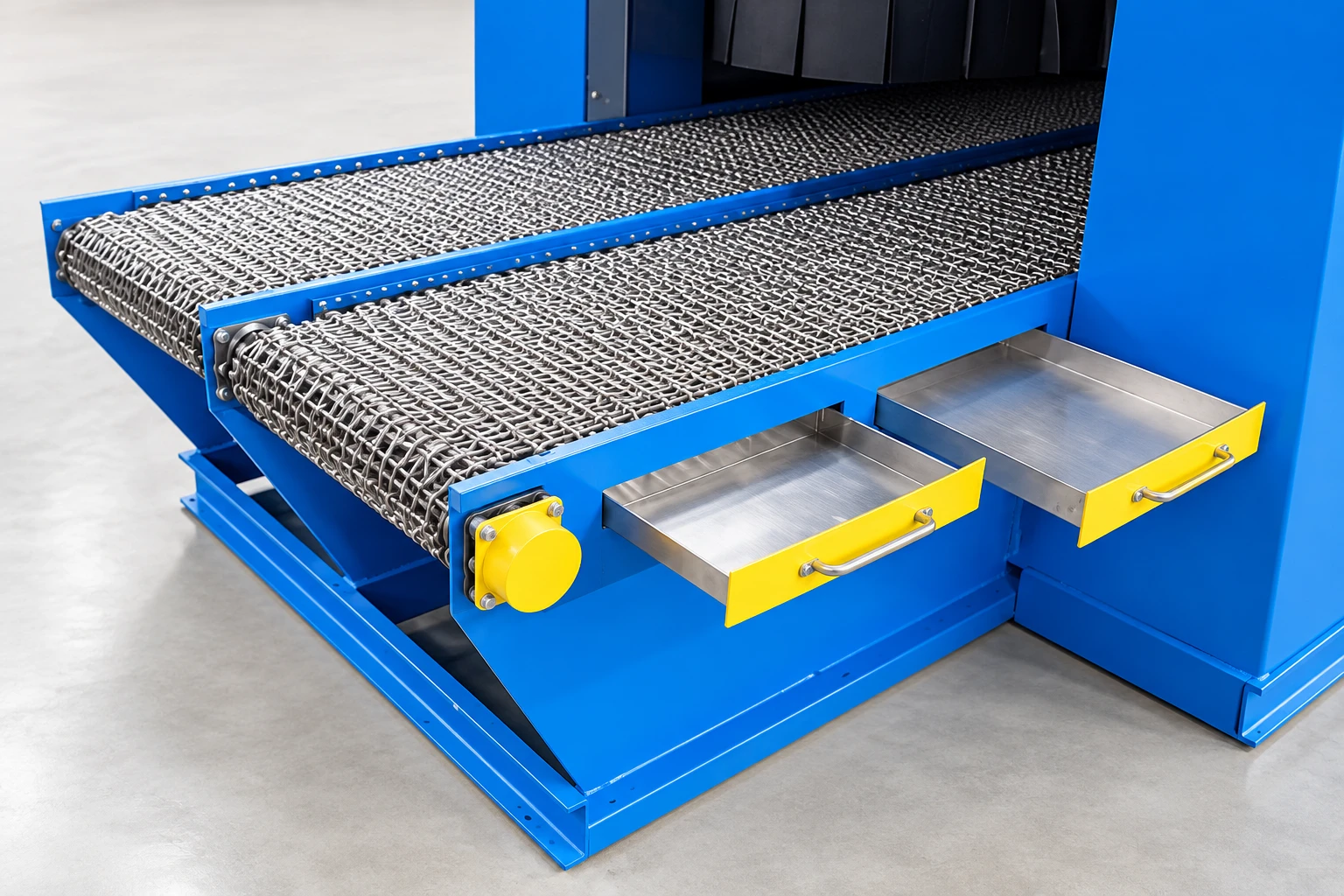
- Belt Conveyors: Continuous material handling systems suited for applications where parts are supported directly on a belt or mesh conveyor.
Conveyor systems can be configured for continuous, indexing, or power-and-free operation, allowing the finishing line to accommodate required dwell times, part spacing, accumulation, and production rates. Proper conveyor selection helps minimize manual handling and improve overall process efficiency.

Environmental Rooms for Industrial Coating Applications
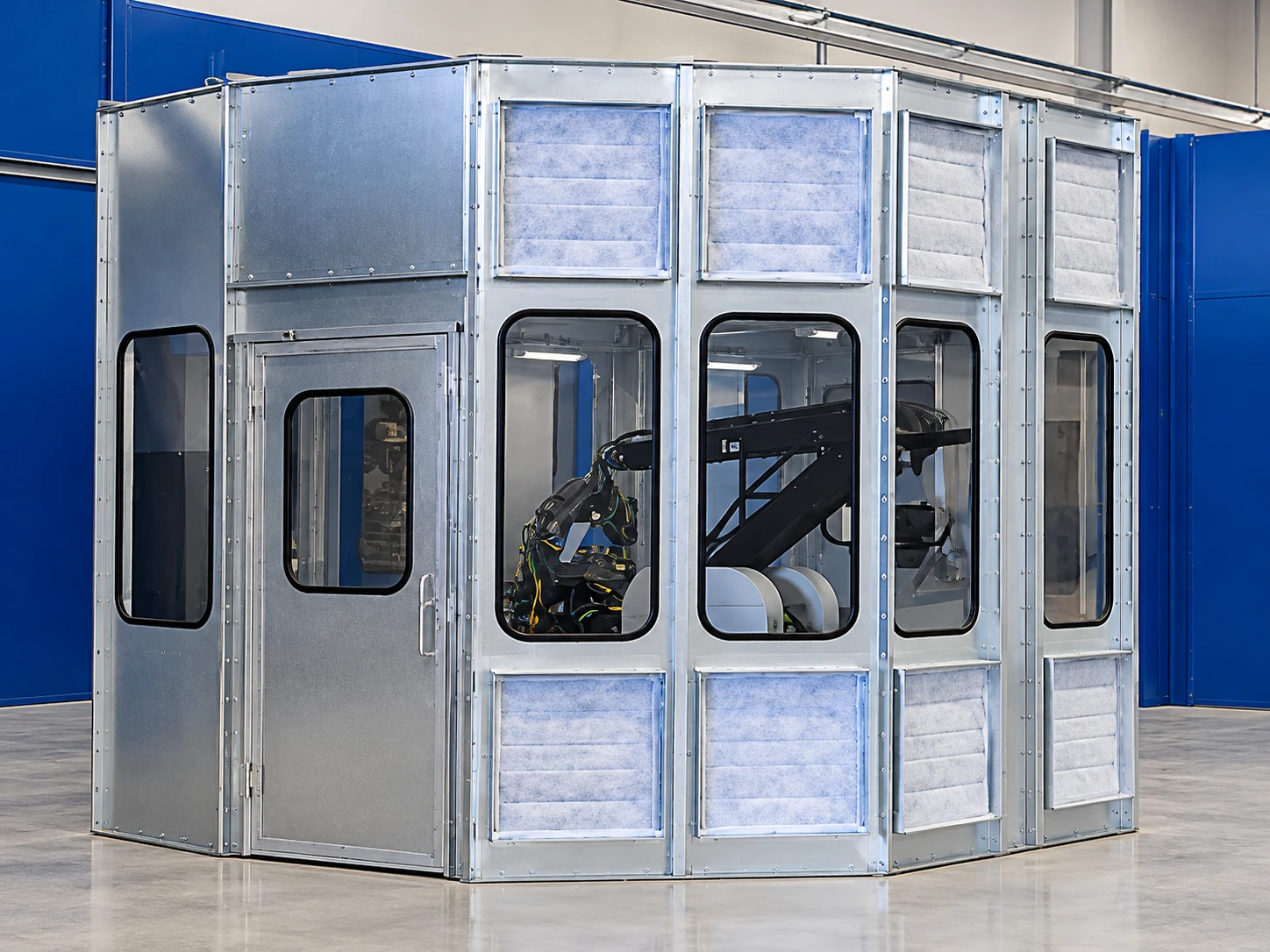
Environmental rooms provide a dedicated enclosed space for powder coating, liquid painting, and related finishing operations. These enclosures help separate coating application areas from surrounding manufacturing activities and support controlled processing conditions.
Depending on the application, Horizon environmental rooms may include:
- Steel wall construction with acrylic enamel finish
- Suspended ceiling systems
- High-efficiency LED lighting
- Personnel access doors with windows
- Optional overhead access doors
- Electrical outlets and supporting electrical provisions
Integrated Controls and Process Automation
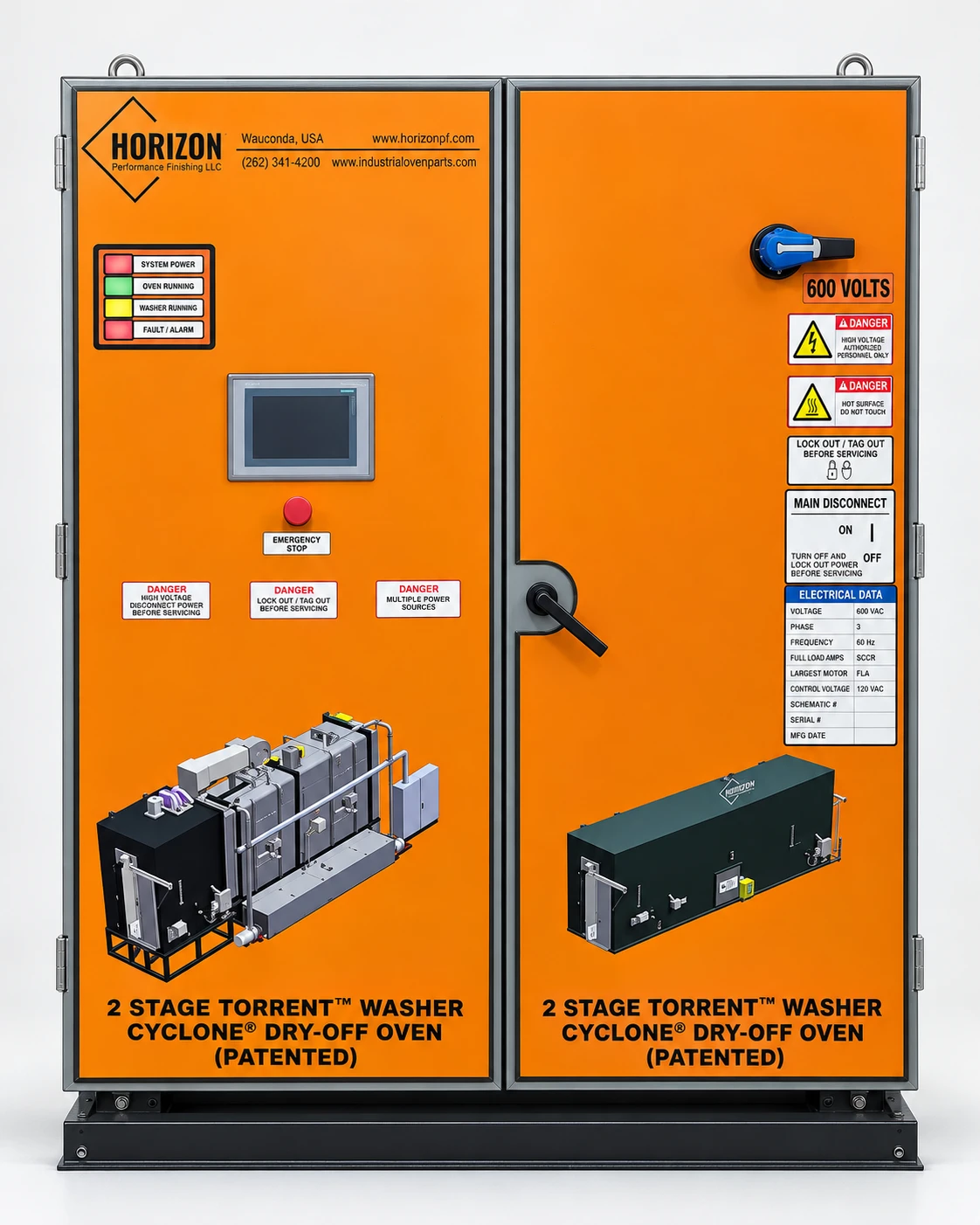
Industrial finishing systems require coordinated control of multiple processing stages to maintain consistent operation and production efficiency. Horizon integrates programmable logic controllers (PLCs), human-machine interfaces (HMIs), temperature controls, and variable frequency drives (VFDs) to manage critical equipment functions. These control systems provide operators with centralized monitoring and adjustment of operating parameters.
Available control system capabilities include:
- Centralized System Control: Multiple equipment power panels integrated with a main control center.
- PLC and Touchscreen HMI: Operator interfaces for monitoring equipment and adjusting process settings.
- Variable Frequency Drives: Control of washer pumps, oven recirculation fans, and other motors according to process requirements.
- Temperature Control: Digital temperature controllers interfaced with the PLC for monitoring and regulation.
- Safety Monitoring: PLC monitoring of critical safety switches, interlocks, and equipment operating conditions.
- Remote Access: Available remote HMI access for authorized monitoring and troubleshooting.
Properly integrated controls help operators maintain repeatable processes, respond to changing production requirements, and identify equipment issues. Learn more about Horizon's industrial control systems and custom control panel capabilities.
Industrial Finishing System Accessories and Support Equipment
Additional equipment and accessories can be incorporated into a finishing system to meet specific cleaning, water quality, emissions, maintenance, and operational requirements. Horizon offers a variety of options to customize each system for its intended application.
Industrial Oven Accessories
- Roof safety railings for personnel protection during approved roof access
- Access ladders for inspection and maintenance
- PLC controls and programmable process recipes
- Roll-up doors for suitable applications operating below 500°F
- Thermal oxidizers for applicable emissions-control requirements
- Thermal oxidizers with heat recovery to support energy efficiency
Pretreatment Water Treatment and Quality Control
Water quality can directly influence cleaning performance, chemical pretreatment, and final coating quality. Depending on process chemistry and water specifications, industrial pretreatment systems may include:
- Reverse osmosis (RO) water treatment systems
- Carbon filtration for chlorine removal
- Duplex water softeners
- Water transfer and pressurization pumps
- Polyethylene RO water storage tanks
- Conductivity meters for monitoring water quality
- UV water treatment systems for microbial control
Industrial Pretreatment Washer Accessories
Additional washer accessories help maintain cleaning solution quality, remove contaminants, manage moisture, and support reliable operation of industrial pretreatment equipment. Available options include:
- Stainless steel bag filter housings for removal of suspended contaminants
- Magnetic separators for collecting ferrous particles
- Oil coalescers for separating free oils from wash solutions
- Zirconium pretreatment stage filtration
- Internal LED lighting for improved inspection visibility
- Blow-off systems for removing residual water from parts
- Mist eliminators to reduce entrained moisture in exhaust air
By incorporating the appropriate conveyors, environmental enclosures, integrated controls, and process support equipment, Horizon can configure a complete industrial finishing system around each customer's production requirements. From initial system design through installation, start-up, and ongoing service and maintenance , Horizon provides support for efficient, reliable finishing operations.
Ready to Optimize Your Manufacturing Process?
At Horizon, we’re not just building mass produced finishing equipment—we’re creating engineered finishing solutions that move your business forward in a cost-saving, efficient, and reliable way. Our complete solutions include parts washers, finish application environments, and curing ovens that work as a complete process to provide efficient, quality, repeatable results. Contact us today to discuss your application and discover how Horizon's advanced technologies can improve your finishing process.
Contact Us