

Composite manufacturers face a constant challenge: producing identical, high-quality parts cycle after cycle. Whether manufacturing aerospace structures, automotive components, medical devices, or advanced industrial products, success depends on the ability to control every aspect of the composite curing process.
Yet even when manufacturers use identical cure recipes and cycle times, they often encounter unexpected variability. Parts cured under seemingly identical conditions may exhibit differences in mechanical strength, dimensional stability, surface finish, or resin distribution. These inconsistencies create scrap, rework, delays, and quality concerns that impact profitability and customer satisfaction.
Until now, autoclaves were viewed as the benchmark for achieving consistent composite quality. However, advances in composite curing oven technology, airflow engineering, process controls, and out-of-autoclave prepreg materials have fundamentally changed the game. Today's high-performance curing oven systems can deliver exceptional temperature uniformity, process repeatability, and production stability while eliminating many of the costs and complexities associated with legacy autoclaves.
The Critical Role of Temperature Uniformity in Composite Curing
Every composite curing process relies on carefully controlled heat to activate chemical reactions within the resin system. When portions of a part experience different temperatures, cure progression occurs at different rates. This can result in:
- Incomplete resin crosslinking
- Variation in glass transition temperature (Tg) which is the change in temperature at which a polymer or plastic becomes flexible
- Internal stresses
- Warping and distortion
- Reduced mechanical properties
- Voids and porosity
- Surface defects
Temperature uniformity is one of the most important performance requirements for any composite curing oven. However, many manufacturers focus only on chamber air temperature instead of actual part temperature. An oven controller may show that the system is operating within specification, even while significant thermal gradients remain throughout the workload. Horizon’s Cyclone Technology™, for example, is designed to maintain consistent airflow patterns regardless of part geometry or load configuration. By helping heated air reach every area of the workload, this advanced airflow system reduces temperature variation and improves process repeatability.
The same principles apply beyond composites. Whether operating an epoxy curing oven, silicone curing oven, plastic curing oven, rubber curing oven, medical device curing oven, resin curing oven, or solar cell curing ovens, temperature uniformity remains the foundation of consistent product quality. The goal of every composite curing process should be to ensure that every square inch of every part experiences nearly identical thermal conditions throughout the cure cycle. When this occurs, manufacturers achieve greater production stability, improved quality, and significantly higher confidence in the performance of the finished product.
Diagnosing the Common Causes of Thermal and Cure Variability
Many curing challenges originate from airflow and oven design limitations rather than the resin system itself. Traditional curing oven architecture often relies on directional airflow patterns that create uneven heat distribution throughout the chamber. Hot and cold zones naturally develop as airflow follows the path of least resistance.
Several factors commonly contribute to cure variability:
Airflow Short-Circuiting - In poorly engineered systems, heated air travels directly from supply openings back to return ducts without effectively passing across the workload. This reduces heat transfer and creates localized temperature differences.
Advanced oven architectures address this challenge by engineering both supply and return airflow paths. Rather than relying on localized jets or high-pressure discharge points, airflow systems such as Horizon's Cyclone Technology™ utilize balanced circulation patterns designed to distribute heated air throughout the entire chamber before it returns to the recirculation system.
Load Geometry Effects - Large composite tools, molds, and assemblies can obstruct airflow paths and alter circulation patterns. This can cause portions of the workload to heat at different rates, resulting in inconsistent cure progression.
Thermal Mass Differences - Heavy tooling absorbs energy differently than lightweight composite structures. Without proper airflow management, these differences contribute to uneven heating and inconsistent thermal response.
Door Events and Recovery Time - Every time a curing oven door opens, thermal energy escapes. Conventional ovens often require extended recovery periods before returning to stable operating conditions, introducing additional process variation.
Improper Sensor Placement - Limited thermocouple locations can provide a misleading picture of actual thermal conditions throughout the workload. Manufacturers may believe they have achieved temperature uniformity while significant thermal gradients still exist.
The Mechanics of Fluid Dynamics: Vacuum, Pressure, & Airflow
Successful composite manufacturing depends on more than temperature alone. The interaction between vacuum, pressure, and airflow directly influences the effectiveness of the composite curing process.
Understanding Forced Convection - Modern curing systems rely heavily on forced convection to transfer heat from circulating air to the composite structure. Unlike radiant heating alone, forced convection continually moves heated air across the surface of the part. This movement improves thermal consistency and reduces cure variability. The effectiveness of this transfer is measured by the convective heat transfer coefficient. A higher heat transfer coefficient allows thermal energy to move more efficiently from the air to the part, reducing thermal lag and improving process control.
Understanding the Convection Boundary Layer - Every heated surface develops a thick layer of relatively stagnant air known as the convection boundary layer. This convection boundary acts as an insulation between the circulating air and the part surface. If airflow velocity is insufficient, the boundary layer thickens and reduces heat transfer and effectiveness.
One reason modern composite curing ovens achieve higher levels of process control is their ability to continuously disrupt the convection boundary layer. High-volume, low-pressure airflow designs such as Horizon's Cyclone Technology™ promote consistent air velocity around parts, improving the convective heat transfer coefficient without requiring oversized motors or excessive energy consumption. The result is more uniform heating, faster thermal response, and improved cure consistency throughout the workload.
Vacuum's Role in Composite Quality - Vacuum remains a critical component of many composite manufacturing processes. In vacuum bagging application, vacuum removes entrapped air, consolidates laminate layers, and assists resin flow during the composite curing process. Even minor vacuum leaks can affect laminate quality, increase void content, and compromise structural performance. To improve reliability, many modern composite curing ovens incorporate:
- Integrated vacuum ports
- Pressure transducers
- Leak monitoring systems
- Recipe-driven controls
- Data acquisition systems
- Real-time vacuum monitoring
These features help manufacturers maintain consistent vacuum performance while reducing opportunities for operator-induced variability.
Why Advanced Curing Ovens are Replacing Autoclaves
For decades, autoclaves were considered the gold standard for high-performance composite manufacturing. That assumption is rapidly changing. Advancements in airflow engineering, process controls, and out of autoclave prepreg materials have significantly changed the economics of composite production.
The shift toward out-of-autoclave (OOA) manufacturing has accelerated as oven manufacturers have improved temperature control and airflow performance. Modern systems such as Horizon’s CC-Series Composite Curing Ovens are designed to maintain loaded-chamber temperature uniformity as tight as +/-3°F while supporting vacuum bag curing processes that historically required autoclave-based production environments.
Several factors are driving manufacturers toward advanced composite curing oven systems:
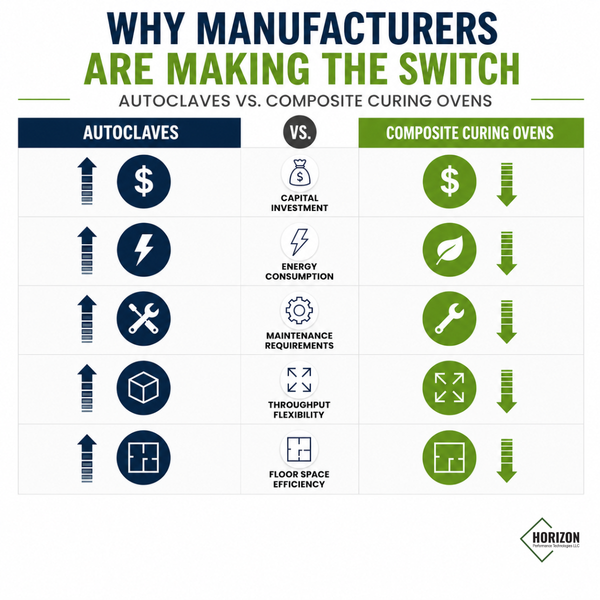
Lower Capital Investment - Autoclaves require significant infrastructure, pressure vessels, safety systems, and installation costs. A modern curing oven typically requires substantially lower capital investment while providing comparable curing capability for many applications.
Reduced Operating Costs - Autoclaves consume large amounts of energy because they must pressurize and heat an entire vessel. Modern carbon fiber curing oven systems focus on maximizing heat transfer efficiency through engineered airflow, reducing energy consumption while maintaining excellent cure quality.
Increased Production Flexibility - Manufacturers often process multiple part sizes, cure cycles, and product configurations. Advanced composite curing ovens provide greater flexibility while accommodating future production changes.
Easier Maintenance - Autoclaves involve complex pressure systems, valves, seals, and certification requirements. By comparison, modern curing ovens typically offer simpler maintenance procedures and reduced downtime.
Sustainability Advantages - Modern thermal processing optimization strategies focus on maximizing heat transfer while minimizing fan horsepower, energy consumption, and carbon emissions. For example, Horizon's Cyclone Technology™ utilizes recirculation motors that are 20-25% the horsepower required by conventional oven designs. By improving airflow efficiency rather than simply increasing fan size, manufacturers can achieve better heat transfer while lowering operating costs and reducing environmental impact.
Engineering a Highly Uniform OOA Production Environment
Achieving autoclave-quality results in an OOA environment requires a comprehensive approach to system design. Success begins with airflow engineering but extends to process controls, vacuum management, and material handling equipment. The most effective composite curing ovens utilize high-volume, low pressure circulation patterns that provide more consistent heat transfer than localized high-velocity jets. Balanced supply and return airflow paths help maintain uniform thermal conditions regardless of load size or geometry.
Some of the most successful OOA installations combine engineered airflow with advanced process controls. Horizon's Cure Commander™ composite curing software allows manufacturers to monitor part temperatures, vacuum performance, thermocouple inputs, and cure profiles in real time while maintaining complete process traceability. Modern composite curing environments often incorporate:
- Recipe-driven controls
- Real-time thermocouple monitoring
- Vacuum pressure monitoring
- Automated data logging
- Alarm tracking
- Leak detection systems
- Process validation reporting
Equally important is the integration of material handling equipment. Carts, fixtures, racks, and loading systems can obstruct airflow and negatively affect temperature uniformity. This is why oven manufacturers should design and engineer their equipment with consideration for the material handling equipment to ensure that airflow systems are not disrupted.
Final Thoughts
The future of composite manufacturing is increasingly defined by precision, efficiency, and repeatability. While autoclaves continue to play a role in certain applications, advances in airflow engineering, forced convection, process controls, and out-of-autoclave prepreg materials have dramatically expanded what is possible with a modern composite curing oven. Modern systems such as Horizon's custom engineered CC-Series Composite Curing Ovens with Cyclone Technology™ demonstrate how engineered airflow, integrated vacuum systems, and advance controls can deliver exceptional process repeatability while supporting the industry's continued transition toward highly efficient out-of-autoclave manufacturing.
Frequently Asked Questions
Why does my composite curing process produce highly variable structural strengths even when using identical cycle times?
Variability is often caused by uneven heat transfer rather than cycle time difference. Poor airflow distribution, inconsistent vacuum performance, thermal mass variations, and inadequate temperature uniformity can create significant differences in resin cure progression across a part.
How do forced convection and air velocity affect the convective heat transfer coefficient inside a modern curing oven?
Forced convection increases air movement across the part surface, disrupting the convection boundary layer and increasing the convective heat transfer coefficient. High heat transfer efficiency promotes more uniform heating and improved cure consistency.
What role does material handling equipment play in protecting or disrupting strict temperature uniformity requirements?
Material handling equipment directly affects airflow patterns within the curing oven. Poorly designed carts, racks, or fixtures can block circulation and create thermal gradients. Optimized systems support uniform airflow and contribute to improved process repeatability and overall cure quality.