
In many manufacturing settings, parts cleaning is treated as a support step instead of an important part of the process. In fact, it’s one of the most important steps. If oils, chips, fines, soils, or residues remain on a component, downstream operations such as coating, welding, bonding, assembly, or heat treatment can suffer.
Improving parts cleaning involves more than adding extra pressure or increasing cycle time. It requires understanding how the entire industrial cleaning process works: chemistry, temperature, mechanical action, rinse quality, drying, equipment design, and repeatability.
For manufacturers looking to improve throughput, reduce waste, and achieve more consistent results, the right industrial washer design can make a measurable difference. Advanced technology such as Horizon washers with Torrent Technology™ are engineered for peak efficiency while lowering operating costs.
What Impacts Performance in Industrial Parts Cleaning
Several variables directly affect cleaning performance in any industrial parts washer. When one is overlooked, results become inconsistent.
- Part Geometry – Complex parts with blind spaces, holes, recesses, threads, pockets, and internal passages are harder to clean than flat surfaces. Spray patterns must reach every critical area, not just exposed surfaces.
- Impurity Type – Different contaminants require different cleaning approaches. Common impurities include:
- Machining oils
- Coolants
- Grease
- Carbon deposits
- Metal fines
- Buffing compounds
- Dust and debris
An industrial cleaning system must be matched to the type and amount of contamination being removed.
- Temperature – Heat improves many aqueous clean process applications by reducing viscosity, loosening soils, and accelerating chemical action. However, excessive or insufficient temperature can reduce efficiency or damage parts.
- Chemistry – Detergent selection, concentration, pH, and compatibility with the substrate all matter. Even a high-quality washer can underperform if chemistry is not properly managed.
- Mechanical Action – Mechanical energy is what physically removes contamination. This comes from spray impingement, solution movement, agitation, or targeted nozzle coverage. Uniform mechanical action is often the difference between acceptable cleaning and repeatable cleaning.
- Time – Better results don’t always come from longer cycles. Poor coverage, weak chemistry, or inconsistent spray patterns can waste time without improving cleanliness.
- Rinse and Drying Stages – Cleaning doesn’t end when soils are removed. Residual detergent, spotting, and retained moisture can create a whole new set of problems if rinse and drying stages are not optimized.
What Defines Cleanliness in Industrial Cleaning Systems
Many companies say they need parts to be “clean”, but that word can have different meanings depending on the application. Defining cleanliness is one of the best ways to improve industrial parts cleaning performance. Here are some examples:
- Visual Cleanliness – For some applications, clean means no visible oil, dirt, or residue on the surface.
- Functional Cleanliness – For precision components, clean may mean the part performs properly in assembly, coating, sealing, or bonding.
- Measured Cleanliness – Some manufacturers use measurable standards such as:
- Residual contaminant levels
- Particle counts
- Surface energy
- Water-break-free testing
- Adhesion test results
- Salt spray performance after coating
- Gravimetric analysis/Millipore test/Solvent extraction test
- Process Consistency – A part that is clean once is not enough. The true goal is to achieve the same result every shift, every batch, and every production run.
When cleanliness standards are clearly defined, the industrial cleaning process can be designed around real requirements instead of guesswork.
How to Prevent Common Washer Failure Modes
Even experienced operations teams can face recurring issues that reduce cleaning performance. Many common washer failure modes are preventable with better system design and maintenance practices.
Inconsistent Spray Coverage: If nozzles are poorly positioned, clogged, or unable to reach recessed features, contamination can be left behind.
To Prevent: Use engineered spray coverage, inspect nozzles regularly, and verify cleaning on actual production parts.
Dirty or Saturated Solution: When wash solution becomes overloaded with soil, cleaning effectiveness drops quickly.
To Prevent: Implement filtration, skimming, tank maintenance, and scheduled solution management.
Incorrect Chemical Concentration: Too little chemistry may fail to clean. Too much may increase cost, foam, or residue.
To Prevent: Standardize concentration checks and work closely with your chemical provider.
Temperature Drift: Low solution temperature often reduces wash performance and increases cycle times.
To Prevent: Verify heaters, sensors, controls, and recovery performance.
Excessive Carryover Between Stages: When wash chemistry enters rinse stages, rinse quality suffers and operating costs rise.
To Prevent: Use effective draining, blow-off, and stage isolation methods.
Equipment Downtime: Pump wear, clogged strainers, leaks, and neglected maintenance can interrupt production.
To Prevent: Use preventive maintenance schedules and select durable industrial cleaning systems built for serviceability.
What Impacts Cost and Waste in Industrial Cleaning Systems
Improving cleaning results should not come at the expense of excessive operating cost. Many facilities overspend because hidden waste drivers, like the following, are never addressed:
- Water Consumption: Older systems often use more water than necessary through inefficient spray design, overflow, or poor rinse control.
- Chemical Usage: Overdosing detergent or frequent dump-and-recharge cycles increase chemical spending and disposal costs.
- Energy Consumption: Heating water, powering pumps, and running exhaust systems can significantly affect utility costs.
- Labor: Manual rewash, troubleshooting, maintenance delays, and quality checks consume valuable labor hours.
- Scrap and Rework: Poor industrial parts cleaning can cause coating failures, rejected assemblies, adhesion issues, and downstream defects.
- Downtime: When a washer becomes unreliable, the cost is often greater than repairs alone. Production interruptions can affect the entire line.
The best long-term solution is to improve process efficiency while reducing waste at the equipment level.
How Torrent Technology™ Improves Cleaning Consistency
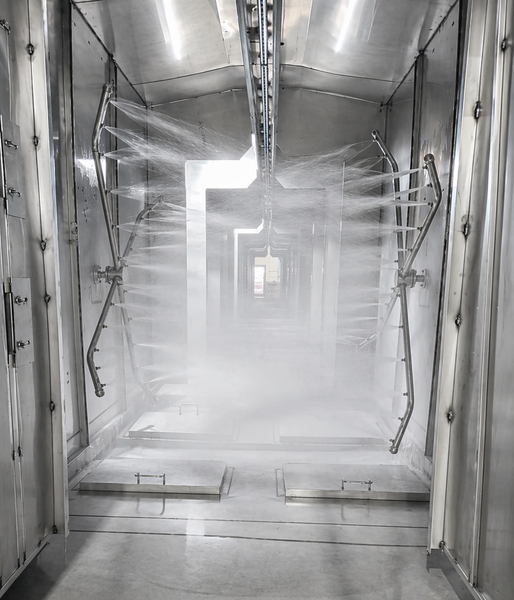
Horizon industrial washers with Torrent Technology™ are engineered to address the common limitations of conventional spray systems. Instead of relying solely on fixed spray positions, Torrent Technology™ uses rotating riser bars with attached nozzles that move in a circular pattern. This creates dynamic 360° spray coverage with more points of impingement across part surfaces and hard-to-reach areas.
Benefits of Torrent Technology™
- More complete spray coverage on complex parts
- Improved cleaning consistency from batch to batch
- Fewer nozzles required compared with many conventional designs
- Reduced water and chemical consumption
- Lower pump horsepower requirements
- Lower chemical treatment and disposal costs
- Improved overall cleaning performance
Because the system is designed around coverage and efficiency, manufacturers can often improve results while lowering total operating costs.
For facilities evaluating a new industrial washer, upgrading an aqueous parts washer, or improving an existing industrial cleaning process, equipment design matters. Horizon washers with Torrent Technology™ helps manufacturers move beyond “good enough” cleaning and achieve repeatable, measurable performance.
Moving to Better Cleaning Results
Improving parts cleaning performance starts with frequently asked questions:
- What level of cleanliness is actually required?
- Where is inconsistency coming from?
- Which variables drive waste?
- Is our current washer designed for today’s parts and production goals?
If your current system is struggling with coverage, repeatability, or operating costs, it may be time to evaluate a smarter approach to your industrial cleaning system.