

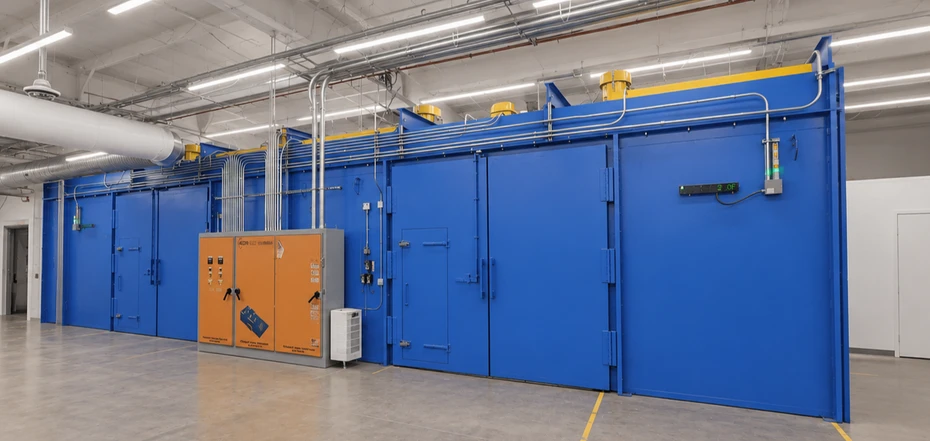
Choosing how to heat an industrial oven involves more than deciding between gas and electricity. The heat source determines how thermal energy for the oven is generated, but it is only one part of the overall heating system.
For manufacturers, the more important question is: How effectively does that heat reach the product?
An industrial oven can have plenty of heating capacity and still struggle with slow heat-up, uneven product temperatures, long recovery times, or inconsistent results if heated air is not distributed effectively throughout the chamber. Understanding the relationship between the heat source, airflow system, controls, oven construction, and production load can help engineers and plant managers specify equipment that performs reliably under real production conditions.
What heats an industrial oven? Heat source vs. Airflow Design
In a convection industrial oven, the heating system generates thermal energy while the air recirculation system transfers much of that energy to the product. Think of these as two separate functions:
The heat source generates the heat. Gas burners or electric heating elements raise the temperature of the process air.
The airflow system distributes the heat. Recirculation fans move heated air through the oven chamber, across the product and back toward the heating system.
Both must be properly designed. A larger burner or additional electric heating capacity may allow an oven to generate heat faster but simply adding more heat hoes not guarantee better temperature uniformity or faster product heating. If airflow is poorly distributed, some areas of the load may receive significantly more convective heat transfer than others.
Gas-Fired Heating: How It Works and Where It Fits
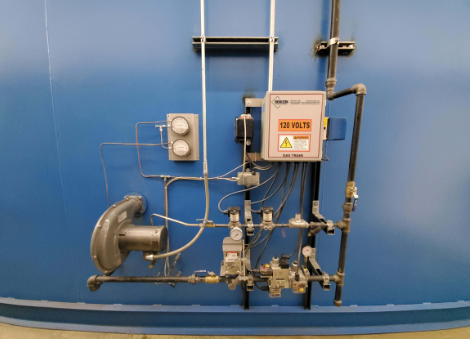
Gas-fired industrial ovens typically use natural gas or propane burners to heat the process air. Burner capacity is generally specified in BTUs per hour (BTU/hr.).
The amount of heating capacity required depends on factors including:
- Operating temperature
- Product mass
- Product geometry
- Desired heat-up time
- Exhaust requirements
- Production rate
- Heat loss through the oven body
- Frequency of door openings or product changes
Industrial burner capacities can range from hundreds of thousands to several million BTU/hr depending on the application. Horizon, for example, designs gas-fired industrial ovens with heating capacities of up to approximately 10 million BTU/hr for larger systems.
Gas heating can be particularly practical for large batch ovens, conveyor ovens, high-throughput applications and processes with substantial thermal loads.
One of its primary considerations is operating economics. Where natural gas is readily available and favorably priced compared with electricity, gas may provide an attractive long-term energy cost. However, actual operating cost depends heavily on local utility rates, oven efficiency, operating temperature, production schedule and exhaust requirements. Gas systems also require appropriate combustion controls, gas trains, ventilation and safety systems designed for the specific oven and application.
Electric Heating Elements: How They Work and Where They Fit
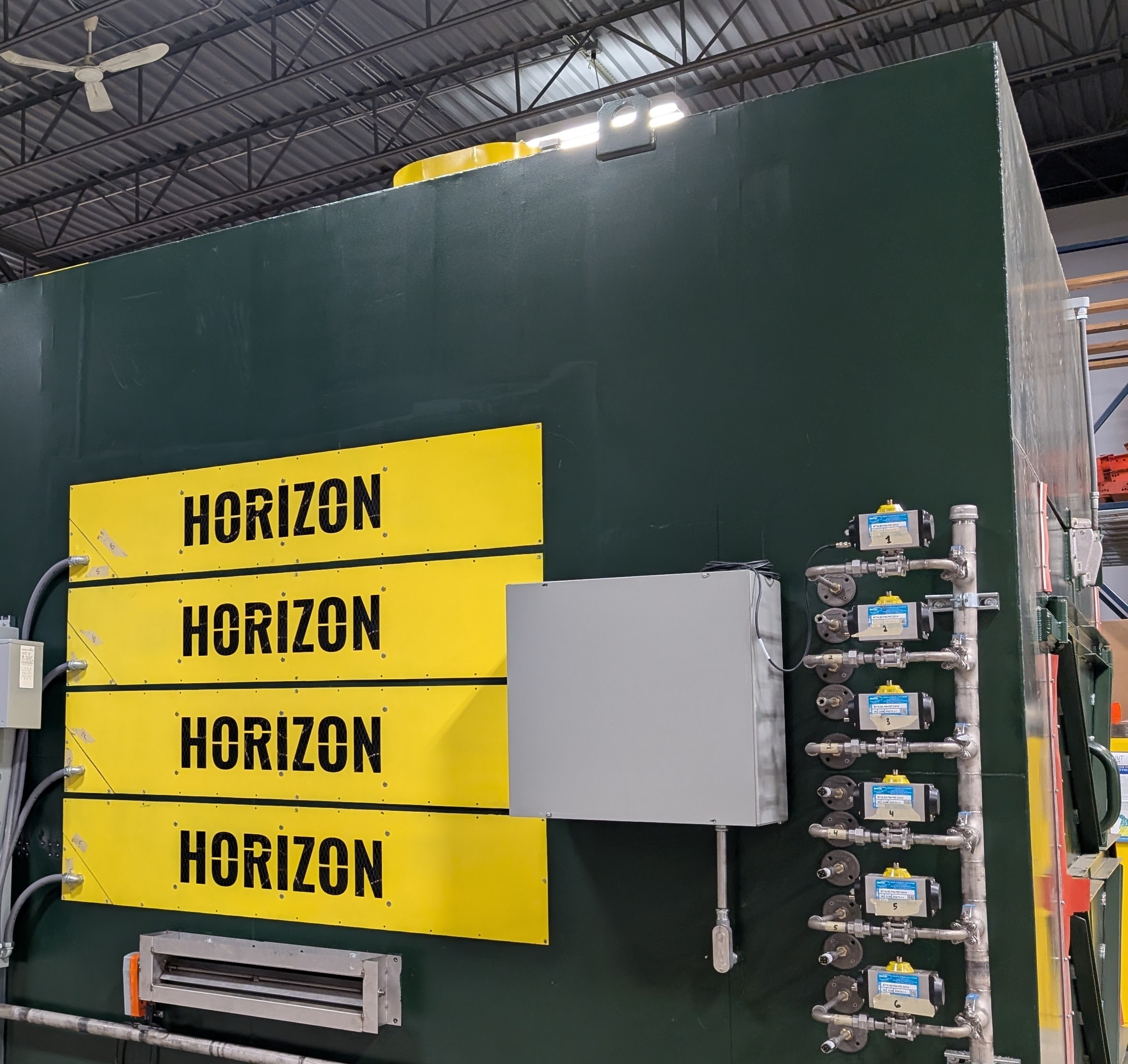
Electric industrial ovens typically use resistance heating elements. Electrical current passes through the element, generating heat that is transferred to the recirculating process air.
Electric heating eliminates combustion at the heat source, making it particularly useful when a process requires a clean heating environment or when natural gas is unavailable or undesirable.
Electric systems can also provide excellent controllability. Both electric and gas heating elements can be divided into multiple stages or zones and controlled according to the temperature requirements for the process.
Applications may include:
- Composite curing
- Adhesive curing and bonding
- Electronics manufacturing
- Laboratory and R&D processes
- Heat treating
- Smaller batch processes
- Processes requiring precise temperature control
One important consideration is available electrical service. Large industrial ovens can require substantial electrical capacity, which means engineers should evaluate the facility’s available voltage, amperage and overall electrical infrastructure early in the equipment selection process. Horizon industrial ovens can be configured with electric heating systems up to approximately 2 MW, depending on the application.
Electric heating also does not automatically eliminate the need for oven exhaust. Certain processes release moisture, solvents, VOCs or other substances that still require ventilation regardless of how the heat itself is generated.
Direct-Fired vs. Indirect-Fired Gas Systems
Gas-fired industrial ovens can be further divided into direct-fired and indirect-fired systems.
In a direct-fired oven, combustion gases enter the recirculating process-air stream. The burner heats the air directly, and the products of combustion become part of the oven atmosphere. This approach provides efficient transfer of heat from the burner to the recirculating air and is common in many industrial curing, drying, and heat-processing applications.
In an indirect-fired oven, the burner heats a heat exchanger instead. The oven’s recirculating air passes over the heat exchanger and receives heat without mixing directly with combustion gases. This separation can be important when the product or process should not be exposed to combustion by-products. Depending on the application and applicable standards, indirect-fired systems may therefore be considered for certain food, pharmaceutical, coating, composite or other process-sensitive applications.
The correct configuration depends on the product, process chemistry, operating temperature and regulatory requirements, not simply on a preference for one burner style over another.
Why Heating Method Alone Doesn’t Determine Temperature Uniformity
It is easy to assume that choosing electric heat automatically produces a more uniform oven, or that installing a higher-capacity gas burner will make a product heat faster.
Neither assumption tells the complete story.
Temperature uniformity is influenced by the interaction of several variables:
- Airflow volume and direction
- Air velocity at the product
- Supply and return-air locations
- Part spacing and load configuration
- Oven insulation and construction
- Door leakage and infiltration
- Exhaust volume
- Control strategy
- Thermocouple location
- Product mass and geometry
Most importantly, there is a difference between heating the oven air and heating the product.
A control thermocouple may indicate that the oven has reached its setpoint while a heavy part, densely loaded cart, or complex component remains considerably colder.
The real process objective is not simply to achieve a particular air temperature; it is to transfer the required amount of heat into the product consistently and within the required process time. That makes airflow a critical part of industrial oven performance.
How Cyclone Technology™ Improves Performance with Either Heat Source
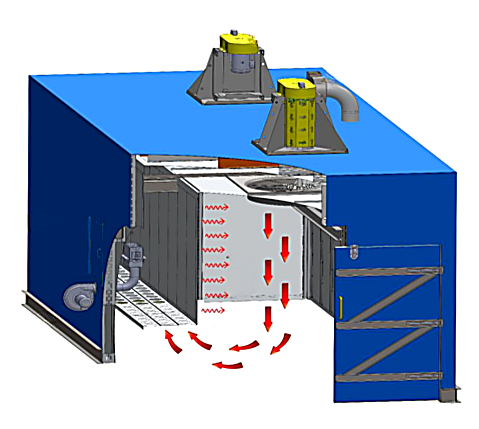
This is where Horizon’s patented Cyclone Technology™ changes the discussion.
Cyclone Technology™ is designed around high-volume, low-pressure air circulation rather than relying on narrow high-pressure streams of air. The object is to move a greater volume of heated air throughout the chamber and across more of the product surface. After air transfers heat to the load, it returns through the oven’s recirculation system, is reheated, and sent through the chamber again.
Effective circulation can improve convective heat transfer while reducing temperature differences throughout the usable workspace. Horizon Cyclone Ovens™ can achieve temperature uniformity of ±3°F or better, depending on the oven and process requirements.
The important point is that Cyclone Technology™ is not limited to one heating method. Horizon ovens can use gas burners or electric heating elements while applying the same fundamental airflow philosophy. In other words, the heat source determines where the energy comes from. Cyclone Technology™ helps determine how effectively that energy reaches the product.
That distinction can have a direct effect on cycle time, recovery after loading, process repeatability, and overall energy use.
Questions to Ask When Choosing an Industrial Oven Heating Method
Rather than beginning with “Should I buy gas or electric?” manufacturers should start with the process.
Ask:
- What temperature must the product actually reach?
- How quickly must it reach that temperature?
- How much product mass will enter the oven?
- Is the process batch or continuous?
- How often will doors open or new product enter the chamber?
- Does the product require protection from combustion gases?
- What natural gas and electrical capacity are already available in the facility?
- What are the local gas and electricity rates?
- Does the process generate moisture, fumes, solvents, or VOCs requiring exhaust?
- What temperature uniformity is required?
- How will parts be arranged so heated air can reach the entire load?
- Could production requirements increase in the future?
Answering these questions allows the heating system, airflow design, and controls to be engineered around the process instead of selecting a heat source first and trying to make the process fit afterward.
For manufacturers comparing the infrastructure and operating considerations of the two energy sources specifically, see our Gas vs. Electric Industrial Ovens: Complete Comparison Guide.
Ultimately, gas-fired and electric industrial ovens can both deliver excellent thermal processing performance when properly engineered. The better question isn’t simply “Gas or electric?”
It’s “How do we generate, distribute, and control heat so the product receives exactly what the process requires?”
At Horizon Performance Technologies, our industrial ovens combine the appropriate heating method with patented Cyclone Technology™ to improve airflow, heat transfer, temperature uniformity, and energy efficiency. Contact our team to discuss the thermal requirements of your application and determine the industrial oven configuration best suited to your process.