

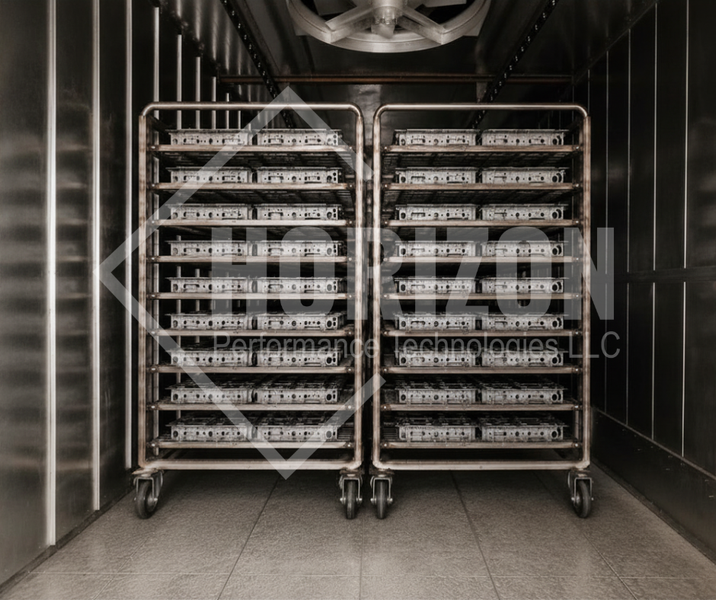
Mastering Process Repeatability and Consistency: Eliminating Variation with Thermal Processing Optimization
Manufacturers depend on process repeatability to maintain quality, reduce waste, and create stable production environments. Yet many thermal systems appear repeatable only under ideal conditions. Once production variables change, process variation begins. Some of these changes include heavier part loads, inconsistent spacing, mixed materials, and varying airflow resistance.
In most operations, thermal processing optimization is more than simply reaching temperature. It is about maintaining stable and repeatable thermal conditions throughout the entire process, regardless of changing production demands. Whether the application involves heat treating, thermoforming, annealing metal, composite curing, or a powder coating treatment, long-term production stability depends on controlling the not-so-obvious variables that negatively influence temperature uniformity and heat transfer consistency.
Today’s manufacturers are increasingly focused on production stability because inconsistency quietly creates expensive operational problems like:
• Scrap and rework
• Longer cycle times
• Inconsistent product quality
• Expensive energy waste
• Unpredictable throughput
• Difficult process validation
• Necessary operator adjustments
The challenge is that many of these problems originate from thermal variation that cannot always be seen immediately on the production floor.
At Horizon Performance Technologies, thermal processing optimization focuses on designing systems that maintain repeatable airflow, balanced heat transfer, and reliable temperature uniformity under real production conditions, not just in empty chamber testing.
________________________________________
The Illusion of Process Repeatability in Thermal Processing
On the surface, many thermal systems appear stable during commissioning or laboratory style testing. Empty chamber temperature readings may look excellent, and initial process runs may provide acceptable results. However, true process repeatability is only proven when a system performs consistently during real world production.
A thermal process can seem repeatable while hidden variation slowly develops under changing conditions such as:
• Larger production batches
• Increased load density
• Door openings
• Airflow obstruction
• Different part geometries
• Product spacing inconsistencies
• Variable moisture content
• Conveyor loading variation
This is where temperature uniformity becomes critical.
In industrial ovens and thermal systems, repeatability is most heavily influenced by how effectively airflow reaches every surface of the product load. Poor airflow management can create troublesome hot and cold zones that lead to inconsistent curing, uneven heat treatment, unstable thermoforming conditions, or inconsistent powder coating results.
Manufacturers often assume that if an oven reaches setpoint, the process is stable. In reality, the actual product temperature may vary significantly throughout the chamber depending on load configuration and airflow behavior.
This becomes especially important in processes such as:
• Industrial tempering
• Heat treating
• Annealing metal
• Industrial stress relieving
• Annealing plastic
• Shrink fitting
• Metal ageing process applications
• Case hardening process operations
• Composite curing process environments
In each of these applications, thermal consistency directly affects final product quality and process repeatability.
A properly engineered thermal system must maintain:
• Stable airflow patterns
• Controlled heat transfer
• Reliable recovery rates
• Balanced chamber circulation
• Consistent thermal exposure
• Predictable production stability
Without these conditions, manufacturers often experience process drift that slowly reduces repeatability over time.
________________________________________
Identifying Hidden Variables: From Annealing Metal to Composite Curing
Many production problems are caused not by equipment failure, but by hidden process variables that disrupt thermal consistency.
The difficulty is that these variables may not appear during basic oven qualification testing. They only become visible during full production operation.
For example, during annealing metal applications, tightly packed product loads may block airflow pathways and create inconsistent heat penetration. In heat treatment and industrial tempering application, part geometry can create thermal shadows that prevent uniform exposure across the workload.
Similarly, in a composite curing process, airflow imbalance can produce localized temperature variation that impacts on resin cure quality, dimensional stability, and overall part consistency.
Processes such as thermoforming, annealing plastic, and industrial stress relieving are also highly sensitive to temperature uniformity because material behavior changes rapidly with even small temperature shifts.
Common hidden variables affecting process repeatability include:
• Load density
• Rack design
• Conveyor obstruction
• Part spacing
• Product orientation
• Airflow short circuiting
• Recovery lag after door openings
• Inconsistent exhaust balancing
• Poor return airflow management
• Mixed product sizes
• Uneven thermal mass distribution
Many manufacturers attempt to resolve these issues by increasing burner size, adding fan horsepower, or raising temperatures. However, thermal processing optimization is rarely solved by simply increasing heat input.
The more effective approach is improving airflow management and thermal distribution throughout the chamber.
Horizon Cyclone Technology™ was specifically developed to improve temperature uniformity through balanced, full-chamber airflow management. Instead of relying on high-pressure directional airflow alone, the system creates stable supply and return circulation patterns that help maintain consistent thermal exposure across changing production loads. In fact, the Cyclone Oven™ boasts the best temperature uniformity in the industry.
This approach helps improve:
• Process repeatability
• Production stability
• Heat transfer efficiency
• Recovery performance
• Product consistency
• Energy efficiency
________________________________________
Optimizing the Powder Coating Oven: The Impact of Load Geometry
The powder coating oven is one of the clearest examples of how load geometry influences process repeatability.
In powder coating applications, inconsistent airflow exposure can create:
• Uneven cure conditions
• Variable gloss levels
• Adhesion problems
• Incomplete curing
• Overbaking
• Color inconsistency
• Rework and scrap
Many powder coating oven problems are not caused by burner capacity. They are caused by airflow disruption created by the production load itself.
As racks become denser or product geometry changes, airflow paths may become blocked or redirected. This changes how heat reaches the product and can significantly impact temperature uniformity throughout the chamber.
For example:
• Flat panels may restrict circulation differently than tubular components
• Deep recesses may trap cooler air
• Tight part spacing may reduce heat penetration
• Large thermal masses may slow recovery time
Thermal processing optimization requires designing airflow systems that continue performing consistently despite changing production conditions.
This same principle applies beyond the powder coating oven into:
• Heat treating systems
• Thermoforming operations
• Shrink fitting applications
• Case hardening process equipment
• Composite curing process systems
• Industrial stress relieving ovens
Consistent process repeatability depends on how well the thermal system adapts to real production loads instead of ideal laboratory conditions.
At Horizon, airflow engineering focuses on maintaining temperature uniformity even under heavily loaded operating conditions. Stable chamber circulation helps reduce variation while improving production stability across multiple thermal process applications.
________________________________________
Material Handling Equipment and Its Role in Thermal Stability
Many manufacturers overlook the impact that material handling equipment has on process repeatability and temperature uniformity.
Conveyors, racks, carts, fixtures, and other load carriers directly influence airflow behavior inside thermal systems. Poorly designed material handling equipment can unintentionally disrupt circulation patterns and create inconsistent thermal exposure.
Examples include:
• Solid shelving blocking airflow
• Dense fixtures restricting return circulation
• Uneven rack spacing
• Oversized carriers creating airflow shadows
• Conveyor systems altering chamber pressure balance
Even minor airflow disruptions can impact:
• Heat treatment consistency
• Powder coating oven cure quality
• Annealing metal performance
• Composite curing process stability
• Thermoforming consistency
• Industrial tempering repeatability
In continuous production environments, material handling equipment also influences production stability by affecting:
• Product spacing
• Conveyor speed consistency
• Load timing
• Exposure duration
• Heat recovery rates
This is why thermal processing optimization should include both the oven system and the production handling strategy.
At Horizon Performance Technologies, thermal systems and material handling equipment are often engineered together to help maintain balanced airflow and consistent thermal exposure throughout the production cycle.
This approach to integrated system design helps improve:
• Process reliability
• Temperature uniformity
• Throughput consistency
• Operational efficiency
• Production stability
• Long-term thermal performance
________________________________________
A Roadmap for Thermal Process Optimization
Improving process repeatability starts with understanding that thermal consistency is influenced by far more than chamber temperature alone.
Manufacturers seeking better production stability should evaluate the full thermal process, including:
• Airflow design
• Supply and return circulation
• Load geometry
• Rack and fixture configuration
• Material handling equipment
• Recovery performance
• Product spacing
• Thermal mass variation
• Exhaust balancing
• Conveyor behavior
Successful thermal processing optimization typically follows several key steps:
1. Evaluate Real Production Conditions
Empty chamber testing rarely tells the full story. Validation should occur under actual loads and operation conditions.
2. Analyze Airflow Performance
Understanding how airflow moves through the chamber is critical to improving temperature uniformity and process repeatability.
3. Review Load Geometry
Part spacing, orientation, and thermal mass distribution all influence thermal consistency.
4. Assess Material Handling Equipment
Racks, carts, and conveyors should support airflow rather than obstruct it.
5. Monitor Recovery Performance
Stable recovery after door openings and load changes is essential for production stability.
6. Focus on Consistency Over Peak Temperature
The goal of thermal process optimization is not simply higher heat output. It is maintaining stable and repeatable thermal exposure over time.
Whether the application involves heat treating, industrial tempering, thermoforming, annealing plastic, annealing metal, shrink fitting, or operation of a powder coating oven, long-term process repeatability depends on eliminating variation throughout the system.
Horizon Performance Technologies designs industrial thermal systems with a focus on balanced airflow, temperature uniformity, and production stability to help manufacturers improve consistency under real-world operating conditions.
To learn more about Horizon thermal processing systems and Cyclone Technology™, visit Horizon Performance Technologies or Request a Quote.