
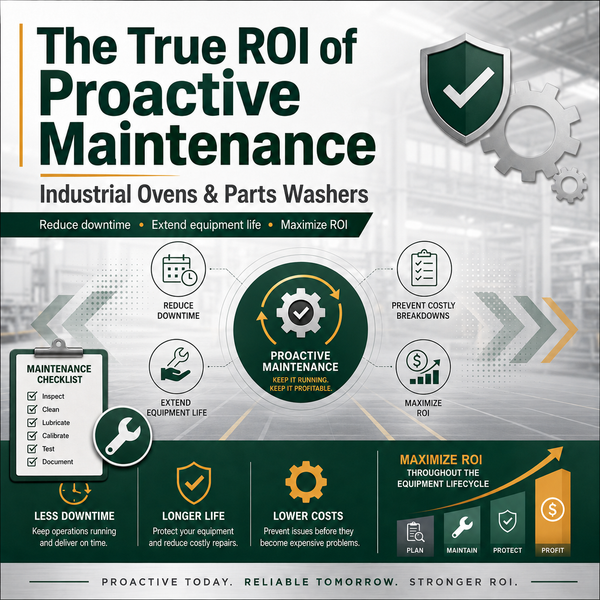
The purchase price of manufacturing equipment is only one part of its true cost. Over years of production, uptime, operating efficiency, product quality, repair expenses, and service life often have a greater effect on return on investment.
Strong manufacturing equipment ROI begins with two decisions:
- Selecting durable, well-designed industrial equipment
- Maintaining that equipment before problems interrupt production
This applies across a manufacturing facility, but it is especially important for industrial ovens and industrial parts washers that support critical heating, curing, drying, cleaning, and surface preparation processes.
A lower-cost machine may appear attractive during purchasing. However, difficult service access, inconsistent performance, unavailable parts, excessive energy use, or frequent emergency repairs can quickly erase the initial savings.
Quality construction and proactive industrial equipment maintenance can help manufacturers:
- Protect production throughput
- Reduce unexpected downtime
- Maintain consistent process results
- Control repair and operating costs
- Extend equipment service life
- Improve long-term manufacturing equipment ROI
The Hidden Cost of Hard-to-Service Equipment
Serviceability should be evaluated before equipment is purchased, not after the first component fails.
When burners, motors, fans, pumps, filters, nozzles, sensors, controls, or conveyor drives are difficult to reach, routine work takes longer. Technicians may need to remove unrelated components or extend shutdowns, simply to complete an inspection or repair.
Accessible equipment makes industrial equipment servicing faster and more predictable.
What to Look for in Serviceable Industrial Equipment
- Convenient access doors
- Removable service panels
- Clearly labeled components
- Safe access to major mechanical systems
- Adequate workspace for inspections and repairs
- Organized electrical panels
- Accurate manuals and component documentation
- Clearly identified replacement part numbers
For industrial ovens, maintenance teams need reasonable access.
Industrial Oven Service Access
- Recirculation fans
- Burners or heating elements
- Motors and bearings
- Conveyor components
- Thermocouples and sensors
- Exhaust systems
- Door seals
- Control panels
The same holds true for industrial parts washers.
Industrial Parts Washer Service Access
- Pumps
- Spray nozzles
- Strainers and filters
- Tanks
- Heating systems
- Conveyors
- Oil-removal equipment
- Blow-off components
Equipment that is easier to inspect is more likely to be maintained consistently. Better accessibility can shorten planned shutdowns, reduce labor costs, and help technicians identify developing problems before production stops.
Preventive Maintenance That Pays Off
Reactive maintenance waits until performance declines or equipment fails. Preventive maintenance uses scheduled inspections, cleaning, testing, and component replacement to address deterioration earlier.
Effective industrial equipment servicing should focus on systems most likely to affect uptime, operating cost, process consistency, and product quality.
What a Preventive Maintenance Program Should Include
- Routine visual inspections
- Cleaning and lubrication
- Review of operating trends
- Verification of safety systems
- Scheduled component testing
- Replacement of normal wear items
- Temperature or pressure checks
- A recommended critical spare-parts list
Industrial Oven Maintenance Checklist
- Burner performance
- Gas train components
- Electric heating elements
- Fans, bearings, belts, and motors
- Airflow and exhaust settings
- Door seals and insulation
- Thermocouples and temperature sensors
- Controllers and operating recipes
- Conveyor movement and alignment
- Over-temperature protection
Industrial Parts Washer Maintenance Checklist
- Spray pressure
- Nozzle condition and alignment
- Pump performance
- Strainers and filtration systems
- Tank cleanliness
- Chemical concentration
- Solution temperature
- Conveyor movement
- Oil-removal systems
- Dry and blow-off performance
The goal is not simply to complete a checklist. Maintenance data should reveal changes over time.
Warning Signs of Equipment Deterioration
- Longer oven heat-up times
- Slower temperature recovery
- Declining washer spray pressure
- Increased motor amperage
- Unusual vibration or noise
- Recurring alarms
- Inconsistent cleaning results
- Increased scrap or rework
Planned industrial maintenance services also allow repairs to be coordinated with production schedules. A small issue corrected during a scheduled shutdown is generally less disruptive than an emergency repair during a critical production run.
Why Your Spare Parts Strategy Matters
The right replacement part can save a production day, but only when it is available at the right time.
Manufacturers should identify critical components before equipment enters service. Spare parts decision should consider:
- How likely the component is to wear or fail
- How long replacement delivery may take
- Whether the part is standard or custom
- Whether equipment can operate without it
- What production losses could result from a failure
Critical Spare Parts for Industrial Ovens
- Thermocouples
- Temperature sensors
- Relays and fuses
- Contactors
- Belts and bearings
- Ignition components
- Pressure switches
- Flame rods
- Motors
- Variable-frequency drives
Critical Spare Parts for Industrial Parts Washers
- Spray nozzles
- Pump components
- Valves
- Gaskets and seals
- Strainers
- Filters
- Conveyor components
- Sensors
- Heating components
A continuously operating conveyor oven or conveyor parts washing system may justify more on-site inventory than equipment used only occasionally. For example, custom parts washers and dryers, or a rotary drum parts washer or oven may contain specialized components that should be identified and stocked early.
How to Build a Practical Spare-Parts Strategy
- A documented critical-parts list
- Current equipment serial numbers
- Updated manuals and electrical drawings
- Recommended stocking quantities
- Protected and organized storage
- A process for replenishing used inventory
- A dependable source for replacement components
Working with a reliable supplier of spare parts can further reduce delays.
Spare-parts planning is not unnecessary inventory. It is a form of downtime risk management.
Lifecycle Value vs. Purchase Price
The lowest purchase price does not always produce the lowest operating cost. A more accurate comparison evaluates total cost of ownership.
What Total Cost of Ownership Includes
- Purchase and installation
- Energy and utility consumption
- Production labor
- Routine maintenance
- Replacement parts
- Emergency repairs
- Production downtime
- Scrap and rework
- Equipment replacement
What to Evaluate When Purchasing an Industrial Oven
- Temperature uniformity
- Heat-up and recovery time
- Fan horsepower
- Insulation quality
- Exhaust requirements
- Control capabilities
- Construction quality
- Maintenance accessibility
- Production capacity
- Future expansion needs
What to Evaluate When Purchasing an Industrial Parts Washer
- Water consumption
- Chemical usage
- Pump horsepower
- Cleaning consistency
- Filtration performance
- Maintenance access
- Drying performance
- Production capacity
- Process modifications
Equipment must also fit the process. Oversized systems may waste utilities, while undersized systems can create bottlenecks, excessive cycle times, or inconsistent results.
Matching Industrial Equipment to the Manufacturing Process
Well-engineered industrial equipment should be designed around:
- Part size and geometry
- Load density
- Soil or contaminant level
- Required process temperature
- Production rate
- Cleaning or curing specifications
- Quality expectations
A quality machine may cost more initially but deliver greater long-term value through consistent output, efficient resource use, fewer emergency repairs, and a longer supportable service life.
Why Horizon Industrial Ovens and Washers May Be the Best Long-Term Investment
Horizon designs equipment around process performance, durability, serviceability, and long-term support.
Horizon Industrial Ovens
Horizon industrial ovens are available in batch, conveyor, walk-in, and custom configurations. Cyclone Technology™ is engineered to improve:
- Airflow around the workload
- Heat transfer
- Temperature uniformity (±3°F or better)
- Process consistency
- Energy efficiency
Horizon Industrial Parts Washers
Horizon parts washers include cabinet & batch, belt conveyor, dip-tank, drum, and monorail configurations. Custom parts washers can be designed around the parts, contaminants, production rate, and required cleaning standard. Torrent Technology™ is designed to provide:
- Improved cleaning coverage
- Effective contaminant removal
- Reduced water consumption
- Lower chemical usage
- Lower energy requirements
Industrial Equipment Service and Replacement Parts
Long-term support is also essential to equipment ROI. Horizon provides:
- Preventive maintenance
- Troubleshooting
- Equipment repairs
- System modifications
- Operational efficiency reviews
- Service for many makes and models of industrial ovens and washers
- Access to more than 11,500 replacement parts
The strongest manufacturing equipment ROI does not come from equipment alone. It comes from selecting a reliable system, operating it efficiently, maintaining it proactively, and having access to knowledgeable service and replacement parts throughout its working life.
Frequently Asked Questions
1. How often should industrial equipment maintenance be performed
Maintenance frequency should reflect operating hours, production demands, equipment age, process conditions, and manufacturer recommendations. High-use equipment may require daily or weekly operator checks along with quarterly, semi-annual, or annual professional servicing.
2. What should Industrial oven maintenance include?
Industrial oven maintenance should address burners or heating elements, fans, motors, bearings, belts, airflow, seals, insulation, sensors, thermocouples, controls, conveyors, exhaust systems, and safety devices. Heat-up times, recovery time, and temperature uniformity should also be monitored.
3. What maintenance do industrial parts washers require?
Parts washers typically require inspection of pumps, nozzles, spray pressure, strainers, filters, tanks, chemical concentration, temperature controls, conveyors, oil-removal systems, and blow-off components. Cleaning results should also be monitored so performance deterioration can be corrected early.
4. Which spare parts should manufacturers keep on hand?
Manufacturers should prioritize parts that are likely to wear, have long lead times, or would stop production if they failed. The list should be reviewed after major repairs, system modifications, or changes in production demand.
5. How can manufacturers calculate maintenance ROI?
Compare preventive maintenance costs with the expenses that proactive service may prevent, including:
- Emergency labor
- Expedited parts shipping
- Lost production
- Scrap and rework
- Energy waste
- Missed delivery deadlines
- Premature equipment replacement
Preventing a single major production interruption may justify a significant portion of the annual maintenance investment.
Choosing quality industrial equipment is only the beginning. By combining durable, serviceable industrial ovens and parts washers with proactive maintenance and a dependable spare-parts strategy, manufacturers can reduce downtime, extend equipment life, and achieve a strong return on their investment.