

Reaching the right temperature is only part of what makes an industrial oven perform well.
What really matters is what happens after the heat is turned on. How evenly does that heat fill the chamber? How quickly does it reach the product? Can heated air move freely around the load? And does the oven design match the way production actually runs?
These factors can directly affect cycle time, product quality, energy use, throughput, and process repeatability.
For manufacturers trying to improve an existing process, or specify a new industrial oven, four factors deserve particular attention:
- Temperature uniformity
- Actual product temperature
- Airflow and heat transfer
- The type of oven used for production
Understanding how these variables work together can make troubleshooting easier and help prevent a common mistake: focusing on the oven setpoint while overlooking what is actually happening to the product.
1. Temperature Uniformity and Heat Transfer Are Not the Same Thing
It is easy to use temperature uniformity and heat transfer interchangeably. But they tell you two very different things about oven performance.
Temperature uniformity describes how consistently the oven maintains air temperature throughout its usable workspace. For example, an oven rated for ±5°F uniformity is designed to keep measured chamber temperatures within that specified range under defined operating conditions.
Heat transfer describes how effectively thermal energy moves from that heated air into the product.
Think of it this way: uniformity tells you how even the environment is. Heat transfer tells you how effectively the product is absorbing heat from that environment.
An oven can have excellent air-temperature uniformity while a thick steel component or densely loaded cart still takes considerable time to reach the required process temperature.
Several variables influence heat transfer, including:
- Product material
- Part thickness and mass
- Product shape
- Surface area exposed to circulating air
- Moving air velocity
- Moving air volume
- Rack or cart size/configuration
- Starting product temperature
Why Does Temperature Uniformity Matter?
Good temperature uniformity helps minimize hot and cold areas throughout the oven chamber. That becomes particularly important in applications such as:
- Powder coating
- Composite curing
- Heat treating
- Drying
- Aging
- Preheating
In these processes, uneven temperatures can translate into uneven results.
But there is an important catch: uniform oven air does not automatically mean a uniformly heated product.
A temperature survey can tell you the chamber is performing consistently. The next question should be: Is that heat actually reaching the part?
For reliable thermal processing, manufacturers need to consider both chamber temperature uniformity and heat transfer to the product.
2. Why Oven Setpoint Doesn't Equal Product Temperature
The controller says 350°F. Does that mean the product is 350°F?
Not necessarily.
One of the most important concepts in thermal processing is understanding the difference between oven air temperature and actual product temperature.
The oven setpoint tells the control system what air temperature it is trying to maintain. The product inside the oven has its own thermal journey.
For example, an oven may reach a 350°F setpoint while a large steel part inside the chamber is still only 250°F. That part must continue absorbing thermal energy before it approaches the required process temperature.
Why Does the Product Lag Behind?
The amount of thermal lag depends on factors including:
- Part mass
- Material type
- Part thickness
- Load size
- Product arrangement
- Airflow
- Starting temperature
- Oven recovery time
A small, lightweight component may heat relatively quickly. A massive fabricated assembly can hehave very differently, even when both are sitting in the same 350°F oven.
For critical thermal processes, thermocouples can be attached to or placed within the product to measure actual temperature rather than relying solely on the oven air temperature.
A simplified process might look like this:
Oven reaches setpoint -> Product continues heating -> Product reaches required temperature -> Process dwell or cure time begins
That last step is especially important.
Suppose a process specification requires the product to remain at 350°F for 45 minutes. If the 45-minute clock starts the moment the oven air reaches 350°F, but the product is still at 300°F, the intended process may not actually have occurred.
The question is not simply:
“How long was the oven at temperature?”
It may need to be:
“How long was the product at temperature?”
3. Airflow Has a Major Impact on Heat Transfer and Cycle Time
Temperature gets most of the attention in an industrial oven, but airflow does much of the work.
In a convection oven, circulating heated air carries thermal energy to the product. How effectively that air moves through the chamber and across the product can have a major effect on heating rates and consistency.
Properly delivered airflow can help:
- Increase convective heat transfer
- Reduce product heat-up time
- Improve temperature consistency across a load
- Reduce hot and cold areas
- Improve process repeatability
- Reduce unnecessary total cycle time
- Increase potential production throughput
Poor airflow can have the opposite effect.
Imagine a cart loaded so tightly that heated air hits the outside parts but struggles to reach components in the center. The oven might be maintaining its setpoint perfectly while portions of the load heat much more slowly.
Overloaded carts, tightly packed racks, large products, or poor load placement can restrict circulation.
And this is where manufacturers can end up chasing the wrong solution.
Increasing the oven temperature does not necessarily fix an airflow problem.
Air Volume vs. Air Pressure
Effective industrial oven airflow is not simply a matter of blasting high-pressure air at the product.
For many applications, moving a high volume of heated air throughout the chamber and across a greater portion of the product surface can improve convective heat transfer.
The objective is not to create a few powerful streams of air. It is to expose as much of the load as possible to circulating heating air.
Horizon Performance Technologies' Cyclone Technology™ is designed around this principle.
Rather than relying on narrowly focused airflow, Cyclone Technology™ uses high-volume circulation designed to distribute heated air throughout the oven chamber and across the load.
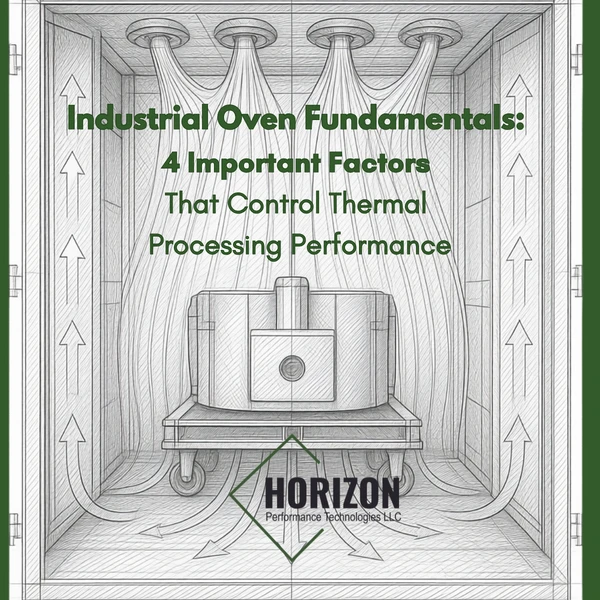
Heated air supplied from the upper portion of the oven spreads throughout the chamber and moves downward over the product. After reaching the lower portion of the chamber, the air is drawn into return plenums where it is reheated and recirculated.
The result is a continuous circulation pattern intended to keep heated air moving around the product while supporting both heat transfer and temperature uniformity.
Load Configuration Matters Too
Even the best airflow system can’t completely overcome a poorly arranged load.
Think about airflow as needing a path.
If racks, carts, or products block that path, certain areas may receive plenty of heated air while others receive much less.
Manufacturers should consider:
- Spacing between parts
- Rack design
- Cart placement
- Product orientation
- Whether large components block air from reaching smaller parts
- Clearance between the load and oven walls
- Changes in load size from one production run to another
When a heating process becomes slower or less consistent, the oven itself might not be the only thing worth checking.
Sometimes the first place to look is at the cart.
4. The Oven Design Must Match the Production Process
Once the thermal requirements are understood, there is another important question:
How does this process need to fit into production?
One of the most common equipment decisions is choosing between a batch oven and conveyor oven.
Both can provide controlled thermal processing, but they solve very different production problems.
When a Batch Oven Makes Sense
Batch ovens process products one load at a time. Parts are commonly loaded onto carts, racks, fixtures, or trays and moved into the oven for a defined heating cycle.
Batch ovens are a good fit when production requires:
- Flexibility in product sizes
- Multiple thermal recipes
- Variable production volumes
- Large or irregularly shaped products
- Car-loaded products
- Long heating or curing cycles
- Frequent changes between products
That flexibility can make batch ovens particularly well suited to job shops, contract finishers, aerospace applications, composite curing, powder coating operations, heat treating, and manufacturers with a diverse product mix.
In other words, if today’s load looks very different from tomorrow’s, batch processing may offer valuable flexibility.
When a Conveyor Oven Makes Sense
Conveyor ovens take a different approach.
Instead of loading an entire batch, products continuously enter, travel through, and exit one or more heated zones at a controlled conveyor speed.
Conveyor ovens are best suited for:
- Higher production volumes
- Continuous manufacturing
- Consistent product sizes
- Predictable production rates
- Repeatable process times
- Automated material handling
- Integration with washers or coating systems
Consider a complete finishing line.
Parts might move through:
Pretreatment washer -> Dry-off oven -> Coating application -> Cure oven
Each step must work with the next.
Conveyor speed, oven length, heating requirements, and required dwell time all become part of the same production equation.
It's Not Just Batch vs. Conveyor
Production volume alone matters, but it should not make the decision by itself.
Other questions include:
- Required product temperature
- Time needed to reach that temperature
- Required time at temperature
- Product dimensions and weight
- Production rate
- Product mix
- Available floor space
- Loading and unloading methods
- Material handling requirements
- Future production changes
The right oven is not simply the one that gets hot enough.
It is the one that can repeatedly deliver the required thermal process while fitting the realities of production.
How Thermal Processing Variables Work Together
Industrial heating is a system.
Changing one variable can affect several others.
A simplified thermal process looks like this:
Oven Setpoint -> Air Temperature -> Airflow -> Heat Transfer -> Product Temperature -> Time at Temperature -> Finished Product
That sequence helps explain why thermal-process problems aren’t always solved by changing the temperature controller.
For example:
- Increasing oven setpoint may not correct issued caused by poor airflow.
- Extending cycle time may compensate for slow heat transfer but reduce throughput.
- Improving airflow may allow products to reach temperature faster without increasing the oven setpoint.
- Good chamber uniformity does not eliminate the need to verify actual product temperature.
- Increasing load density may change airflow and increase product heat-up time.
- Changing product materials or thicknesses may require changes to the thermal recipe.
When a process is not producing consistent results, the best answer may not be “turn up the heat.”
The better question is:
“Which part of the thermal process is limiting performance?”
Questions to Ask When Evaluating an Industrial Oven Process
Before specifying an oven or troubleshooting one already in production, start with the product and work backward.
Ask:
- What temperature must the product reach?
- How quickly must it reach that temperature?
- How long must the product remain at that temperature?
- What temperature variation is acceptable?
- What is the product's size, weight, material, and geometry?
- How much do those characteristics vary from load to load?
- Can heated air circulate freely around the entire product?
- How will products be positioned within the oven?
- How frequently will production recipes change?
- What throughput is required?
- Is the process better suited to batch or continuous production?
- How will actual product temperature be measured or verified?
- Will the oven be integrated with washing, coating, or material handling equipment?
- Is future production growth expected?
Answering these questions can help identify the required oven size, airflow system, controls, material handling, and overall equipment configuration.
More importantly, it helps ensure the oven is designed around the process, not simply around a temperature.
Industrial Oven Performance Starts with the Process
Selecting an industrial oven involves much more than finding equipment capable of reaching a required setpoint.
The oven must provide the airflow, heat transfer, temperature uniformity, product heat-up characteristics, and time-at-temperature necessary for the actual manufacturing process.
At the same time, it must fit practical production requirements such as throughput, product variation, available floor space, loading methods, and integration with other equipment.
Horizon Performance Technologies designs custom batch ovens, conveyor ovens, and complete thermal processing systems around the requirements of the product and process.
Because in industrial heating, the most important question usually isn’t:
“What temperature can the oven reach?”
It is:
“What does the product need the oven to do?”